

TL;DR:
- CEFR levels define specific language skills needed at each proficiency stage from A1 to B2.
- Choosing the right exam depends on your specific goals like university, work, or residency.
- Focused practice with official resources and understanding CEFR descriptors improves exam performance.
Many students spend months preparing for a German language exam without fully understanding what CEFR levels actually measure. They memorize vocabulary lists, work through grammar drills, and then feel blindsided when the exam tests something they didn’t expect. The confusion is real, and it costs valuable study time. CEFR (Common European Framework of Reference for Languages) is the international standard that defines exactly what you should be able to do at each proficiency level. Once you understand how it works, your preparation becomes sharper, more focused, and far more effective. This guide breaks down each level from A1 to B2, maps them to real German exams, and gives you practical strategies to prepare with confidence.
Table of Contents
- Understanding CEFR levels in German language exams
- Popular German exams and CEFR level mapping
- Why CEFR levels matter for study, work, and immigration
- Tips and strategies for mastering CEFR levels in exams
- What most students miss when preparing for German exams
- Prepare smarter: get exam-ready with study tools and practice tests
- Frequently asked questions
Key Takeaways
| Point | Details |
|---|---|
| CEFR sets clear benchmarks | CEFR levels define skill expectations for each German exam, helping you measure proficiency. |
| Match exams to your goals | Choosing the right test prevents wasted effort and aligns your prep with study, work, or immigration needs. |
| Use tailored prep strategies | Level-specific study and practice resources are key to maximizing your German exam scores. |
| Understand real-world impact | CEFR levels open doors in education, employment, and immigration within German-speaking countries. |
Understanding CEFR levels in German language exams
The CEFR is a framework developed by the Council of Europe to standardize language proficiency across countries and institutions. It describes what a learner can do in a language at six levels: A1, A2, B1, B2, C1, and C2. For most German exam candidates, the relevant range is A1 through B2. As noted in German exam certificates, CEFR levels define language proficiency standards across Europe.
Here is a quick breakdown of what each level means for German learners:
- A1 (Beginner): You can introduce yourself, ask simple questions, and understand very basic phrases. Think greetings, numbers, and everyday objects.
- A2 (Elementary): You can handle routine tasks like shopping or filling out a form. Short, familiar conversations are manageable.
- B1 (Intermediate): You can deal with most situations while traveling in a German-speaking country. You understand the main points of clear, standard input on familiar topics.
- B2 (Upper Intermediate): You can interact fluently with native speakers without strain. Complex texts, abstract topics, and nuanced arguments are within reach.
Each level builds directly on the one before it. Skipping levels or misjudging your current proficiency can lead to preparing for the wrong exam. If you are unsure where you currently stand, take our free German level test for a quick A1–C1 grammar, vocabulary, and reading estimate.
The CEFR framework also shapes the content and structure of every certified German exam. The tasks in a B1 exam, for example, are deliberately designed to test whether you can perform B1-level functions in reading (Lesen), listening (Hören), writing (Schreiben), and speaking (Sprechen). This is why certifying German skills for study, work, or immigration always starts with identifying the right CEFR level.
Pro Tip: Before you register for any exam, check the official requirements for your specific goal. A German-taught university programme often requires an academic C1-level credential, while professional and immigration requirements vary by pathway. Knowing your target level upfront prevents wasted effort.
Popular German exams and CEFR level mapping
Not all German exams are the same, and choosing the right one matters. The three most recognized providers are Goethe-Institut, TELC (The European Language Certificates), and DTZ (Deutscher Test für Zuwanderer). Each offers certifications at specific CEFR levels, and they differ in format, focus, and acceptance by institutions.
As confirmed by TELC exam resources, different exams validate specific CEFR levels from A1 to B2 for German. Similarly, Goethe exams certify German language skills at standardized CEFR levels recognized internationally.
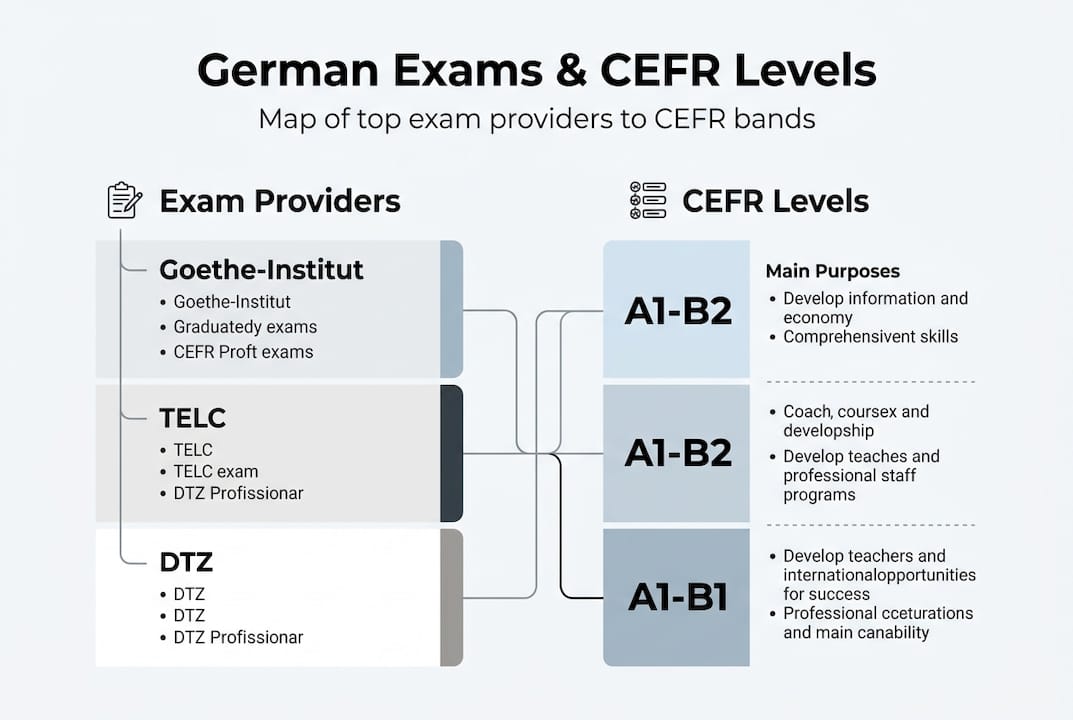
| Exam provider | A1 | A2 | B1 | B2 | Primary use case |
|---|---|---|---|---|---|
| Goethe-Institut | ✓ | ✓ | ✓ | ✓ | Academic, professional, immigration |
| TELC | ✓ | ✓ | ✓ | ✓ | Immigration, integration, professional |
| DTZ | ✗ | ✓ | ✓ | ✗ | Integration courses, residency |
The DTZ is specifically designed for immigrants completing integration courses in Germany. It covers A2 to B1 and is widely accepted for residency applications. The Goethe and TELC exams offer broader coverage and are accepted by universities, employers, and immigration authorities alike.
Choosing the right exam comes down to your goal:
- For German-taught university admission: requirements vary, but TestDaF level 4, DSH-2, or TELC Deutsch C1 Hochschule are common. Always check the exact university and degree programme.
- For a work permit or skilled worker visa: TELC B1 or B2 is often sufficient, depending on the profession.
- For permanent residency or naturalization: DTZ or TELC B1 are standard requirements.
- For integration course completion: DTZ covers A2 to B1 and is the go-to option.
If you want to practice German questions at your target level before committing to an exam date, working through level-specific exercises helps you gauge readiness accurately. Registering for an exam you are not ready for wastes both money and confidence.
Why CEFR levels matter for study, work, and immigration
CEFR levels are not just academic labels. They directly determine whether you qualify for a university program, a job, or a visa. Institutions across Germany and Europe use these benchmarks because they provide a shared, objective standard that everyone understands.
Here is how CEFR levels affect real-world decisions:
- University admission: Most German universities require at least B2 for degree programs taught in German. Some programs accept B1 for preparatory courses, but full enrollment typically demands B2 or higher.
- Work permits: Germany’s Skilled Immigration Act requires varying language levels depending on the profession. Healthcare workers, for example, often need B2 to practice professionally.
- Integration courses: Newcomers to Germany are generally required to complete an integration course that ends with the DTZ exam, covering A2 to B1.
- Permanent residency: The German residence permit (Niederlassungserlaubnis) typically requires at least B1 German proficiency.
- Naturalization: German citizenship applications generally require B1 as a minimum, though higher proficiency strengthens your application.
As detailed in German certification for immigration, CEFR levels are referenced in academic and immigration requirements across Germany.
“Applicants must demonstrate sufficient knowledge of the German language at least at level B1 of the Common European Framework of Reference for Languages.” — Standard wording from German immigration authority guidelines.
Understanding German immigration test requirements before you start studying means you set a clear, realistic goal. You are not just preparing to pass an exam. You are preparing to meet a specific threshold that opens a specific door. That clarity changes how you study, what you prioritize, and how you measure progress.

Tips and strategies for mastering CEFR levels in exams
Knowing the theory is one thing. Actually performing at your target CEFR level on exam day is another. Here are the most effective strategies, organized by what actually works.
Common mistakes at each level:
- A1/A2: Focusing too much on vocabulary memorization and not enough on basic sentence construction and listening comprehension.
- B1: Underestimating the writing section (Schreiben). Many students can speak at B1 but struggle to write structured responses under time pressure.
- B2: Overconfidence with grammar while neglecting the nuanced reading tasks that require inferring meaning, not just understanding words.
Study strategies that work:
- Use official exam formats from the start. Practicing with real exam structures beats generic textbook exercises every time.
- Set weekly goals tied to CEFR descriptors, not just topics. Ask yourself: “Can I now do what a B1 speaker is supposed to do?”
- Practice improving German speaking with timed responses. Speaking fluency drops under exam pressure if you have never practiced with a clock running.
- Review the TELC B1 exam guide or TELC B2 strategy for level-specific breakdowns of what each section tests.
| CEFR level | Recommended prep resources | Key focus area |
|---|---|---|
| A1 | Flashcard apps, basic audio exercises | Vocabulary, greetings, numbers |
| A2 | Grammar drills, short reading texts | Sentence structure, everyday situations |
| B1 | Mock tests, writing practice | Structured writing, listening comprehension |
| B2 | Full-length practice exams, complex texts | Reading inference, fluent speaking |
As shown in research on exam preparation strategies, effective preparation can dramatically improve your German exam scores. Pair that with targeted German grammar test tips and you have a well-rounded approach that covers all four skills.
Pro Tip: Simulate full exam conditions at least twice before your actual test date. Sit in a quiet room, time yourself strictly, and review your answers against the official scoring criteria. This single habit builds both skill and exam-day composure.
What most students miss when preparing for German exams
Here is something most prep guides will not tell you: grammar knowledge alone will not get you to your target CEFR level. Students often spend 80% of their study time on grammar rules and vocabulary lists, then struggle with the listening and speaking sections because those skills need active, repeated practice, not passive review.
Textbooks give you structure, but they rarely reflect how German is actually used in real conversations, official documents, or exam prompts. The students who perform best are those who expose themselves to authentic materials, including podcasts, news articles, and real exam simulations, long before test day.
As highlighted in research on improving German speaking, students often underestimate the importance of targeted practice for their CEFR level. Practicing mastering German questions in realistic formats closes the gap between knowing German and performing in German.
Track your progress against CEFR descriptors, not just test scores. Ask yourself regularly whether you can perform the specific tasks described for your target level. That shift in mindset moves you from studying to prepare for a test to actually building the proficiency the test measures.
Prepare smarter: get exam-ready with study tools and practice tests
If you are ready to move from understanding CEFR levels to actively preparing for your exam, Deutsch-Pruefung.de has the resources to support every step of your journey.
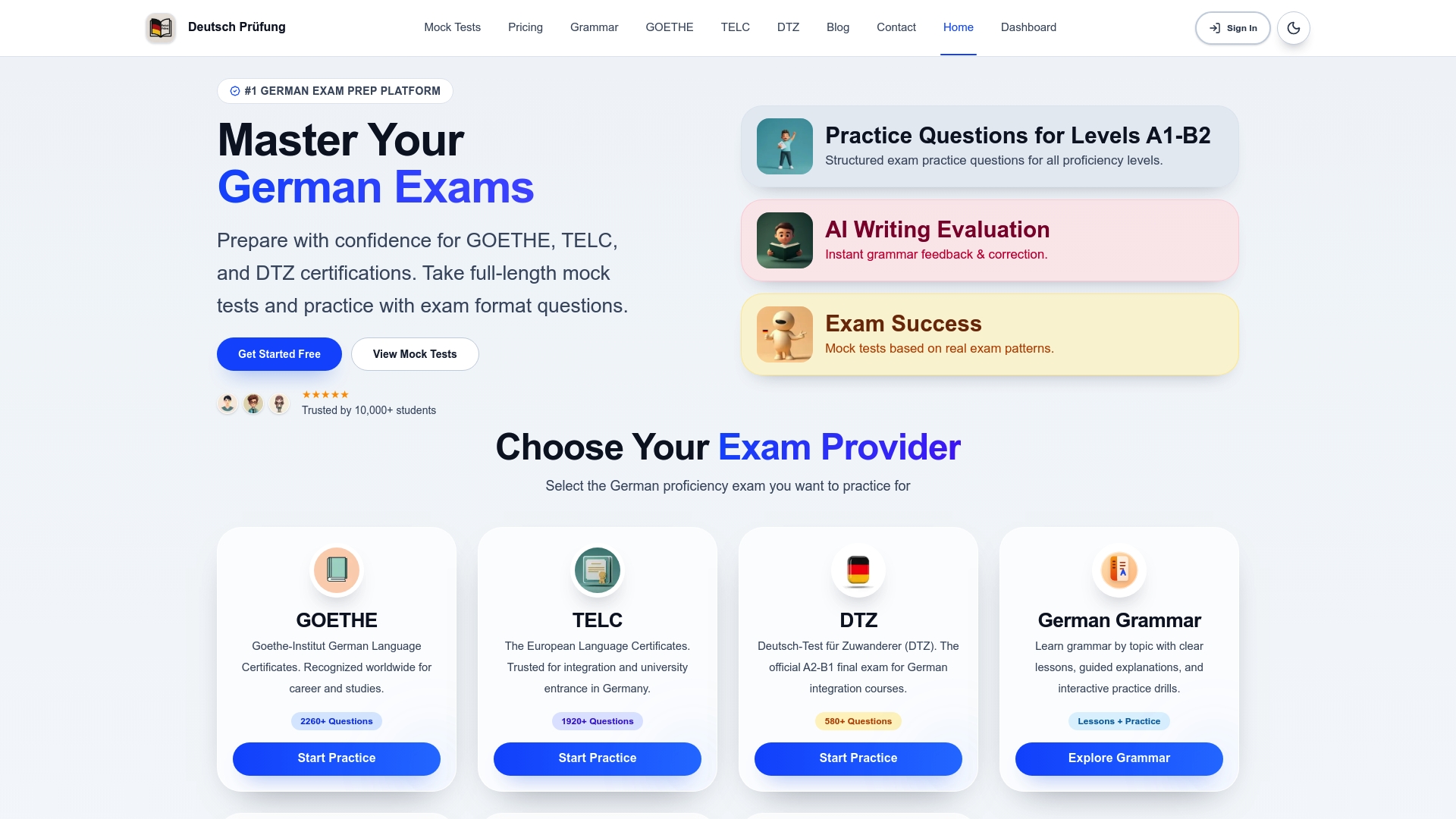
You can access full-length practice exams for every CEFR level from A1 to B2, including realistic mock tests for Goethe exam materials and TELC exam prep. The platform also offers structured German grammar resources, AI-powered writing feedback, and audio exercises to sharpen your listening comprehension. Whether you are just starting at A1 or pushing toward B2 for university or immigration, you will find targeted tools that match exactly where you are and where you need to be.
Frequently asked questions
How do I know which CEFR level to aim for in German exams?
Your target CEFR level depends on your study, work, or immigration requirements. Check official guidelines from your university, employer, or immigration authority, since CEFR levels are referenced in academic and immigration requirements across Germany.
Which German exams match the CEFR levels A1 to B2?
Goethe, TELC, and DTZ exams all include certifications for CEFR levels A1 to B2, with different exams validating specific levels depending on the provider and your intended purpose.
Are practice tests available for my CEFR level?
Yes, full-length practice exams and study materials are available for each CEFR level on platforms like Deutsch-Pruefung.de, where Goethe exams certify German language skills at standardized CEFR levels.
How can I improve my score for a specific CEFR level?
Focus on targeted, level-specific practice and use official exam guides to address common mistakes. Effective preparation strategies can dramatically improve your German exam scores when applied consistently.