
Many learners assume that speaking German fluently is enough to open doors in Germany. It isn’t. Whether you’re applying to a university, pursuing a skilled job, or filing for permanent residency, official German language certification is frequently a hard requirement, not a bonus. B1 is required for permanent residency and citizenship in Germany, and no amount of conversational ability substitutes for a recognized certificate. This guide breaks down why certification matters, which exams exist, how to match your level to your goal, and how to prepare effectively so you walk into the test room with confidence.
Table of Contents
- Why certification matters: Academic, career, and immigration impact
- Types of German language certification: Goethe, TELC, DTZ explained
- Matching certification level to your goals: A1, A2, B1, B2 use cases
- How to prepare for certification: Strategies and resources
- The overlooked value of certification: Beyond exams
- Where to start: Trusted resources for German exam preparation
- Frequently asked questions
Key Takeaways
| Point | Details |
|---|---|
| Certification unlocks opportunities | Proving your German skills officially opens doors to study, work, and immigration across Germany. |
| Exam choice matters | Goethe, TELC, and DTZ exams fit different needs; knowing which suits your goal makes the process smoother. |
| Preparation beats difficulty | Success relies on targeted practice matching the exam format, not just language ability or perceived exam difficulty. |
| Levels drive outcomes | A1 to B2 certifications relate directly to academic, professional, and residency requirements and opportunities. |
| Resources streamline success | Using official guides, mock tests, and expert tips simplifies preparing for and passing your chosen certification. |
Why certification matters: Academic, career, and immigration impact
Certification isn’t just a formality. It’s the difference between getting the job, the visa, or the university seat and being turned away at the door. Official German exams like Goethe, TELC, and DTZ produce results that institutions and government agencies actually accept. Informal fluency, no matter how impressive, simply doesn’t count in these contexts.
Academic admissions at German universities and many international programs require proof of language proficiency at a recognized level. Goethe or TELC certificates at B2 or higher are the standard expectation. Without them, your application is incomplete regardless of your actual ability.
Career opportunities are equally affected. Many employers in Germany, Austria, and Switzerland require documented language skills for hiring, promotion, or licensing in regulated professions. A certificate removes doubt and signals commitment.
Immigration and residency are where certification becomes legally mandatory. Here’s what current requirements look like in practice:
- 🟢 B1 is the standard language threshold for naturalisation and many general settlement-permit routes, subject to statutory exceptions and route-specific rules.
- 🟡 A2 to B1 is required for integration courses and the DTZ exam
- 🔵 EU Blue Card: A1 can support a settlement permit after 27 months of qualifying employment; B1 can reduce that period to 21 months when the other conditions are met.
- 🔴 Informal fluency is never accepted as a substitute in official processes
For a side-by-side look at how the major exams differ in format and recognition, the German exam comparison guide on our exam prep blog covers the key distinctions clearly.
“Certification is not about proving you studied. It’s about proving you can communicate, and doing so in a format that governments and institutions legally recognize.”
The practical impact is real. A B1 certificate can mean the difference between a temporary residence permit and full permanent residency. German-taught university programmes commonly require an academic credential such as TestDaF level 4, DSH-2, or TELC Deutsch C1 Hochschule; the exact requirement is set by the institution and programme. These aren’t small distinctions. They shape your entire trajectory in a German-speaking country.
With the range of potential benefits outlined, it’s important to understand which exams suit different goals.
Types of German language certification: Goethe, TELC, DTZ explained
Three major exam systems dominate German language certification. Each has a distinct format, scoring method, and target audience. Knowing the differences helps you choose strategically rather than randomly.

All three exams test the same four core skills: Lesen (reading), Hören (listening), Schreiben (writing), and Sprechen (speaking). But how they assess and score those skills varies significantly, as outlined in the TELC vs Goethe exam guide.
| Feature | Goethe | TELC | DTZ |
|---|---|---|---|
| Levels available | A1 to C2 | A1 to C1 | A2/B1 combined |
| Scoring method | Modular (pass each skill separately) | Combined score across skills | Combined A2/B1 assessment |
| Developed by | Goethe-Institut | TELC GmbH | BAMF (Federal Office) |
| Best suited for | Academic, international recognition | Practical, workplace, immigration | Integration course graduates |
| Cost | Higher | More affordable | Typically subsidized |
Here’s a closer look at what makes each exam unique:
- Goethe exams use a modular format. You must pass each skill section individually. This means a strong Lesen score won’t compensate for a weak Sprechen result. It rewards well-rounded preparation. Check the A1 writing guide and A1 listening strategies for skill-specific tips.
- TELC exams use combined scoring, which means your total score across sections determines the result. This is more forgiving if one skill is slightly weaker. TELC is also widely available, often more affordable, and has a practical, communicative focus that suits workplace scenarios. For targeted preparation, the TELC B1 exam preparation guide is a strong starting point.
- DTZ (Deutsch-Test für Zuwanderer) was developed by BAMF specifically for integration course participants. It assesses A2 and B1 together in a single sitting. If you’re completing a state-funded integration course, this is likely the exam you’ll take.
“Choosing the wrong exam for your goal is one of the most common and costly mistakes. A DTZ certificate won’t satisfy a university admissions office, and a Goethe A1 won’t meet integration course requirements.”
With the exam types clarified, let’s focus on how to match your goal to the right certification.
Matching certification level to your goals: A1, A2, B1, B2 use cases
Not every goal requires the same level. Choosing the right certification level saves you time, money, and unnecessary stress. Here’s how the levels map to real-life situations.
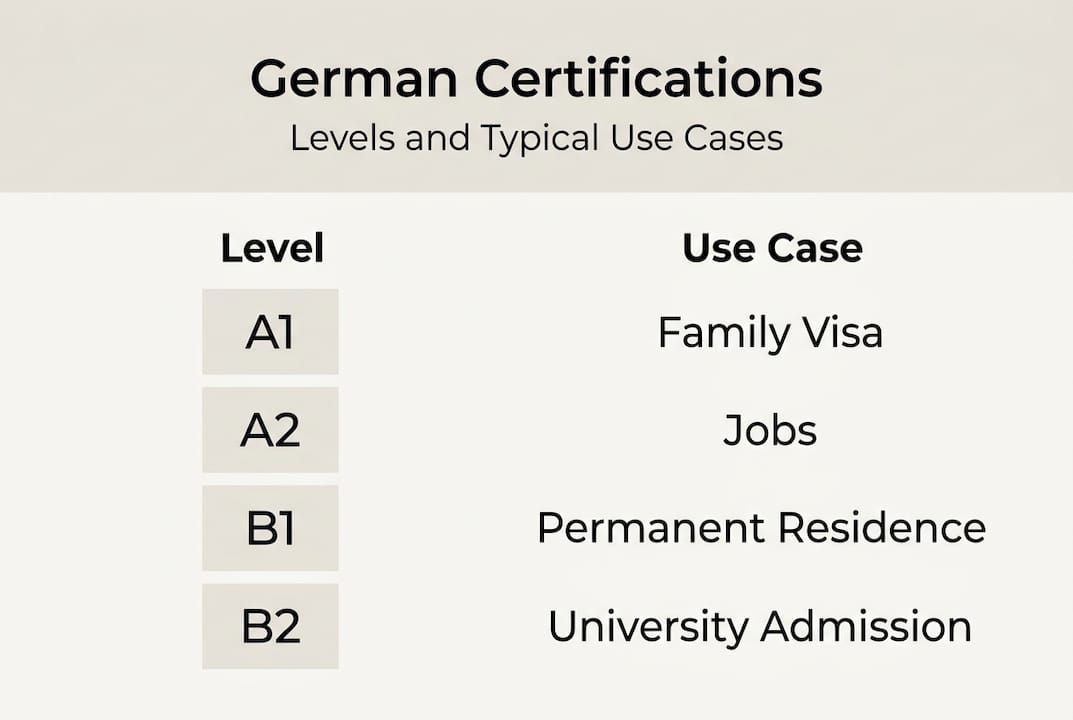
| Level | Common use cases |
|---|---|
| A1 | Family reunification visa, basic entry-level jobs, Blue Card immigration fast-track |
| A2 | Integration course completion, simple administrative roles, basic academic programs |
| B1 | Permanent residency, citizenship, broader employment, trade qualifications |
| B2 | University admissions, skilled professional roles, corporate employment |
According to immigration thresholds, B1 is the minimum for permanent residency and citizenship, while A1/B1 enables Blue Card holders to access accelerated residency pathways.
Here’s a practical way to identify your target level:
- Define your primary goal first. Are you applying for residency, a job, or university?
- Check the specific requirement for that goal. Don’t assume. Look it up or ask the institution.
- Assess your current level honestly. Take a placement test if you’re unsure.
- Choose the exam format that matches both your level and your goal.
- Build a study plan backward from your exam date, focusing on your weakest skills.
Pro Tip: If you’re aiming for B2 for university admission, don’t settle for B1 practice materials. The gap between levels is significant, and under-preparing for your actual target level is a common reason people retake exams. Use Goethe exam prep resources at your exact target level, or explore TELC B2 preparation for structured guidance.
Once you’ve targeted the right exam level, understanding the preparation strategies is key to success.
How to prepare for certification: Strategies and resources
Preparation is where most learners either gain a clear advantage or fall behind. The good news is that effective preparation follows a predictable pattern. The bad news is that many learners rely on passive methods like reading textbooks or watching German TV, which simply don’t replicate what the exam demands.
What actually works:
- ✅ Practice with official exam materials that mirror the real test format exactly
- ✅ Take full-length mock tests under timed conditions to build stamina and pacing
- ✅ Focus on communicative writing in Schreiben, not just grammar rules. The A1 writing strategies blog breaks this down with examples
- ✅ Train your ear with audio exercises that match the Hören section’s speed and accent variety
- ✅ Practice Sprechen with a partner or use structured prompts. The A1 speaking guide and B2 speaking practice resources offer level-specific frameworks
- ✅ Review your mistakes actively. Don’t just note what you got wrong. Understand why
📊 Key insight: Targeted practice matched to your specific exam format is the strongest predictor of success. There is no reliable shortcut through rote memorization or generic study.
Most German certification exams require roughly 60% to pass. That sounds manageable, but the distribution of marks across skills means you can’t afford to completely neglect any section. A weak Sprechen performance can pull your total below the threshold even if your written skills are strong.
Pro Tip: Study in short, focused sessions of 30 to 45 minutes rather than long, unfocused blocks. Research consistently shows spaced repetition and active recall outperform passive review for language retention.
Preparation is crucial, but there are also insights that many test-takers overlook about certification.
The overlooked value of certification: Beyond exams
Here’s something most exam guides won’t tell you: the value of certification isn’t just in the certificate itself. It’s in what passing does to your sense of capability.
When you prepare seriously and pass a formal exam, something shifts. You stop saying “I speak a bit of German” and start saying “I’m certified at B1.” That precision matters. Employers hear it differently. Immigration officers process it differently. University admissions teams recognize it immediately.
But beyond the external recognition, there’s an internal shift too. Learners who earn certification consistently report stronger motivation to continue studying. The certificate becomes a foundation, not a finish line. It opens doors to new professional networks, academic communities, and social circles that informal language use never would.
We’ve seen this pattern repeatedly on our expert tips blog: learners who treat certification as a milestone rather than a chore tend to outperform those who treat it as a bureaucratic hurdle. The mindset matters as much as the method.
Certification is, in the most practical sense, a passport. It travels with you across job applications, visa renewals, university transfers, and professional licensing. Invest in it seriously.
Where to start: Trusted resources for German exam preparation
You now know why certification matters, which exam fits your goal, and how to prepare effectively. The next step is putting that knowledge into action with the right resources.
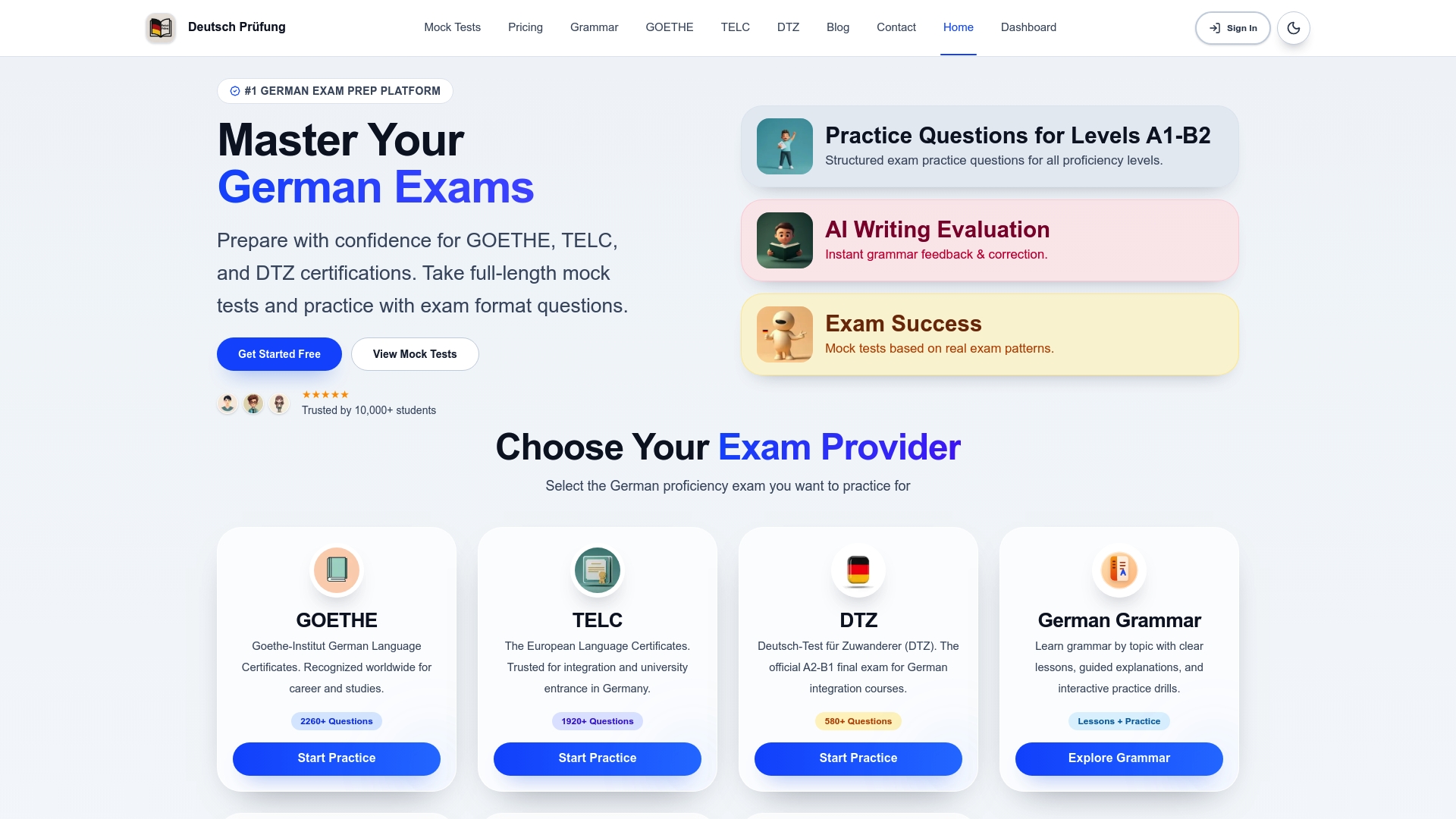
At Deutsch-Pruefung.de, we’ve built a full preparation platform covering every major certification path. Whether you’re targeting Goethe, TELC, or DTZ, you’ll find Goethe practice tests, TELC practice tests, and DTZ practice exams designed to mirror the real exam experience. Our mock tests, AI-powered writing feedback, audio exercises, and expert guides cover A1 through B2. You can start with a free trial and build from there. Your certification goal is reachable. Start with the right tools.
Frequently asked questions
Is German certification required for permanent residency in Germany?
B1 is the standard threshold for naturalisation and many general settlement-permit routes, but exceptions and facilitated routes exist. EU Blue Card holders can qualify after 27 months with A1 or after 21 months with B1 when all other conditions are met.
Which German exam is easier: Goethe, TELC, or DTZ?
Difficulty depends on your learning style and strengths. TELC is often considered more practical and accessible, but as the exam comparison guide explains, matching your preparation to the specific exam format matters far more than which exam you choose.
Can you use informal German skills instead of certification?
No. Universities, employers, and government agencies require official test results from recognized exams. Informal fluency, even at a high level, is not accepted as a substitute in any formal application process.
What is the typical pass threshold for German language certification exams?
Most exams require around 60% to pass, but the key to success is targeted preparation that mirrors the specific exam format and skill distribution, not just reaching a general language level.
Do certification levels (A1 to B2) match specific job or academic requirements?
A1 and A2 support basic communication, while B1 is a common threshold for naturalisation and many settlement routes. German-taught university admission usually requires a programme-specific academic language credential, often at C1 level.