

You’ve studied the grammar rules. You’ve memorized vocabulary lists. Yet when it’s time to actually speak German in your certification exam, the words just don’t come. This is one of the most common frustrations among candidates preparing for GOETHE, TELC, and DTZ exams at levels A1 through B2. Speaking fluency is often the skill that separates a pass from a fail, yet it’s the one most learners practice the least. This guide walks you through targeted, evidence-backed strategies to measurably improve your spoken German and walk into your exam with real confidence.
Table of Contents
- Understand exam speaking requirements
- Build a daily German speaking routine
- Expand your vocabulary for speaking fluency
- Simulate exam conditions with mock tests
- Track progress and adjust your method
- Why most German learners plateau with speaking—and how to break through
- Take your German speaking exam prep further
- Frequently asked questions
Key Takeaways
| Point | Details |
|---|---|
| Target real exam tasks | Focusing on certification-specific speaking prompts boosts exam performance. |
| Practice consistently | Daily, structured speaking practice is the most reliable way to improve fluency and confidence. |
| Simulate exam scenarios | Timed, exam-like speaking practice prepares you for real test conditions and reduces anxiety. |
| Expand and deploy vocabulary | Learning vocabulary by theme and using it in context makes your responses more natural and complete. |
| Track and refine progress | Regularly reviewing your performance highlights strengths and uncovers areas for focused improvement. |
Understand exam speaking requirements
Before you practice a single word, you need to know exactly what each exam asks you to do. The speaking sections of GOETHE, TELC, and DTZ exams are not identical, and preparing for the wrong format wastes valuable time.
Here’s a quick comparison of speaking tasks across major certifications:
| Exam | Level | Speaking tasks | Time |
|---|---|---|---|
| Goethe-Zertifikat | A1 | Personal introduction, simple Q&A | ~15 min |
| TELC Deutsch | A2 | Describing pictures, short role play | ~15 min |
| DTZ | B1 | Role play, giving opinions, discussion | ~15 min |
| Goethe-Zertifikat | B2 | Monologue, discussion, negotiation | ~15 min |
Each exam evaluates you on fluency, pronunciation, vocabulary range, and grammatical accuracy. The B2 speaking practice overview shows how higher-level exams require you to argue a position and respond to a partner’s points, not just describe what you see.
Common speaking prompt types include:
- Personal introductions: Talking about yourself, your job, your hobbies
- Picture descriptions: Describing what you see and making inferences
- Role plays: Simulating real-life situations like booking an appointment
- Opinion tasks: Agreeing, disagreeing, and justifying your view
One of the biggest mistakes candidates make is over-relying on memorized scripts. Examiners notice when you’re reciting rather than speaking. The B1 speaking practice details highlight how spontaneous, natural responses score significantly higher than rehearsed answers. As research confirms, oral language gains directly impact exam comprehension and outcomes, making speaking practice non-negotiable.
Build a daily German speaking routine
Knowing the exam format is step one. The next step is building a speaking habit that compounds over time. Consistency beats intensity every time.
Here’s a practical daily speaking routine you can follow regardless of your level:
- Warm up (5 minutes): Speak aloud about your day in German. Don’t worry about mistakes. Just get your mouth moving.
- Targeted practice (10 minutes): Work on one specific exam task type. Monday could be picture descriptions, Tuesday a role play, and so on.
- Record yourself (5 minutes): Use your phone to record one response. Listen back and note hesitations, mispronunciations, or missing vocabulary.
- Review and correct (5 minutes): Write down two or three improvements and practice the same task again with those corrections in mind.
Cycling through different prompt types across the week ensures you’re not neglecting any part of the exam. If you’re at the A1 level, start with the A1 speaking exercises to build a solid foundation before moving to more complex tasks. For A2 learners, the TELC A2 speaking tips offer structured guidance tailored to that exam’s format.
Practicing with a partner adds a layer of realism that solo drills can’t replicate. A partner gives you unexpected questions and forces you to think on your feet. If you don’t have a study partner, language exchange apps like Tandem or HelloTalk connect you with native speakers.
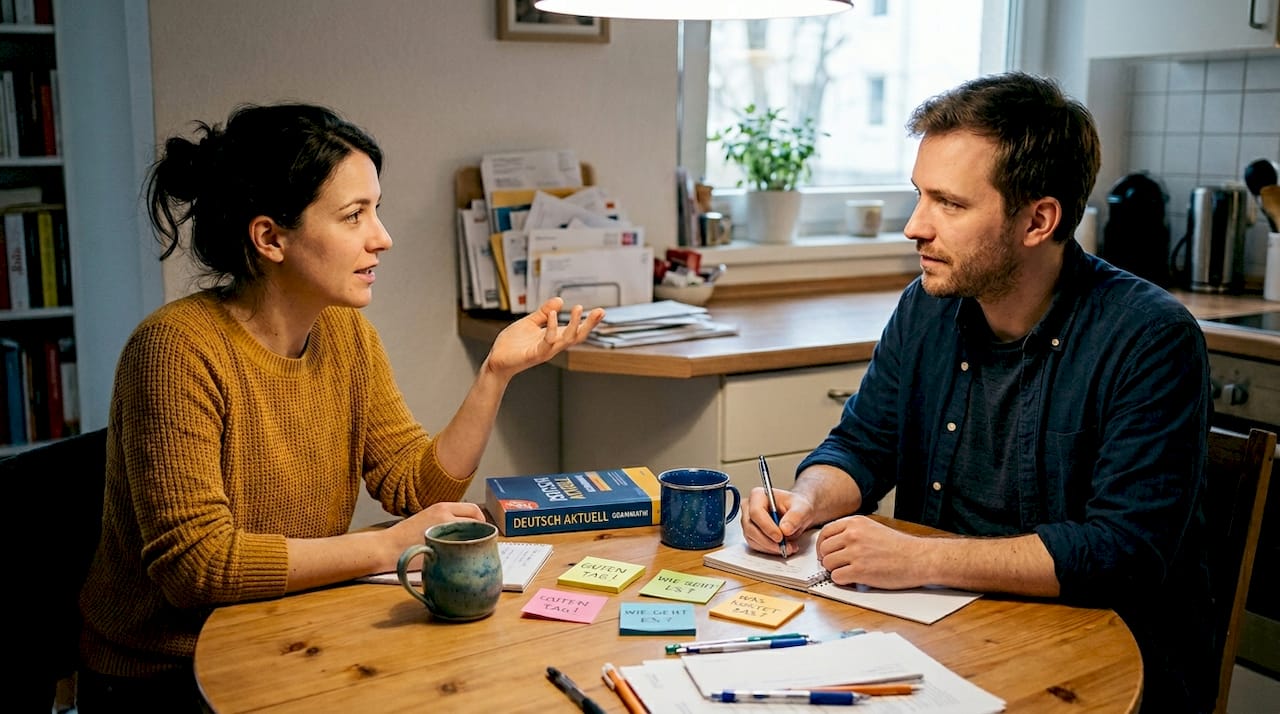
Research shows that consistent speaking practice leads to sustained improvement and 70%+ pass rates on mock exams, making daily routines one of the highest-return investments in your preparation.
Pro Tip: Keep a speaking journal. After each session, jot down the words you struggled with, the phrases you reached for but couldn’t find, and the grammar patterns that tripped you up. Review it weekly and you’ll start to see clear patterns in your weak spots.
Expand your vocabulary for speaking fluency
Fluency isn’t just about grammar. It’s about having the right word available at the right moment. Vocabulary gaps cause hesitation, and hesitation costs you points.
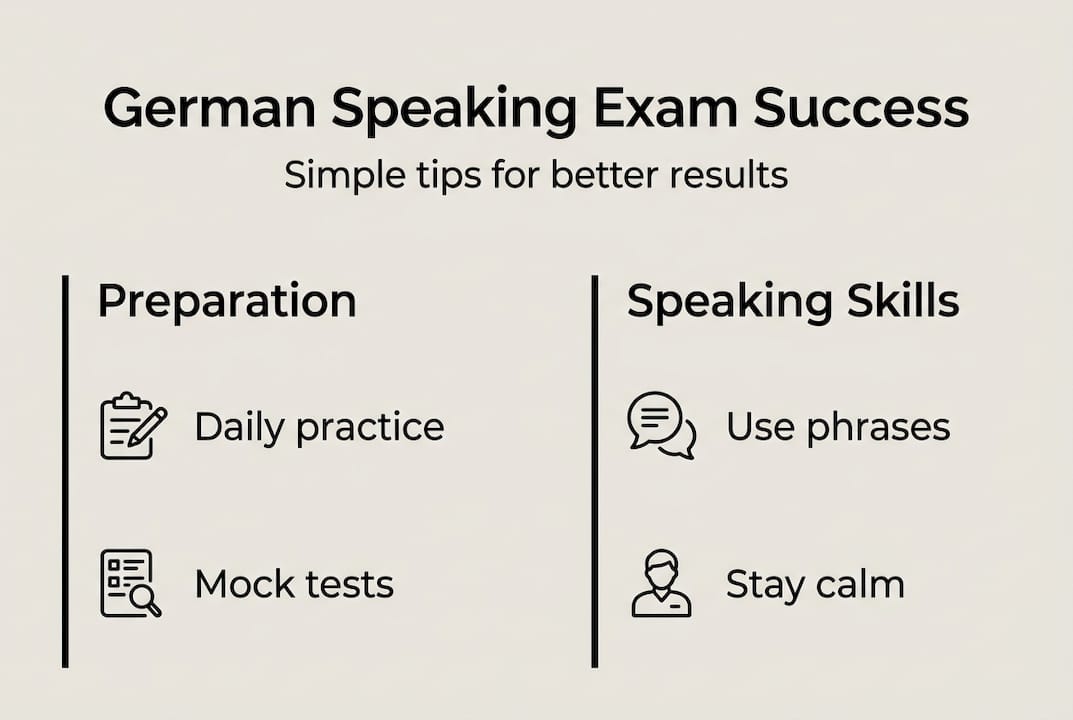
German certification exams at A1 to B2 levels consistently test a predictable set of themes. Organizing your vocabulary study around these themes is far more efficient than learning random word lists.
| Theme | Example vocabulary | Useful phrases |
|---|---|---|
| Work | Beruf, Kollege, Bewerbung | Ich arbeite als… |
| Hobbies | Freizeit, Sport, Musik | In meiner Freizeit… |
| Travel | Reise, Flughafen, Hotel | Ich fahre gern nach… |
| Daily routine | Alltag, Morgen, Abend | Jeden Tag stehe ich um… |
| Opinions | Meinung, Vorteil, Nachteil | Ich bin der Meinung, dass… |
Beyond single words, focus on transition phrases and fillers that make your speech sound natural. Phrases like also (so), eigentlich (actually), and zum Beispiel (for example) help you connect ideas and buy yourself a moment to think without going silent.
Key vocabulary strategies for exam preparation:
- Theme-based learning: Group words by topic and practice them in full sentences, not in isolation
- Active recall: Test yourself by covering the German word and producing it from memory, rather than just reading lists
- Sentence building: For every new word, create a sample sentence you could use in an exam response
- Spaced repetition: Use apps like Anki to review vocabulary at optimal intervals
You can find a structured vocabulary and grammar guide that maps directly to exam requirements. For B1 candidates, the B1 exam vocabulary focus provides topic-specific word sets aligned with Goethe exam themes. As research confirms, vocabulary tailored to exam themes helps with spontaneous and adaptive speaking when it matters most.
Simulate exam conditions with mock tests
Building vocabulary and daily habits creates a strong foundation. But nothing prepares you for exam pressure like actually experiencing it. Simulating real exam conditions is where preparation becomes performance.
Here’s how to run an effective mock speaking session:
- Set the scene: Find a quiet space, set a timer, and treat the session as the real thing. No pausing, no looking things up.
- Use official-style prompts: Pull tasks from practice materials that mirror the actual exam format for your target certification.
- Record your response: Audio or video recording gives you objective evidence of your performance.
- Get feedback: Practice with a language tutor or a study partner who can evaluate your fluency, vocabulary, and coherence.
- Review and repeat: Identify the two or three weakest moments in your response and redo the task focusing specifically on those areas.
“Consistently scoring 70%+ on mock oral tests correlates strongly with certification passes.” This benchmark from TELC B1 preparation research gives you a clear target to aim for before your real exam.
You can access full-length mock German exams that replicate the structure and timing of official tests. For B2 candidates, the sample B2 oral exams include the negotiation and discussion tasks that trip up even well-prepared learners.
Pro Tip: Don’t just repeat mock tasks until you get them right once. Repeat them until you feel genuinely comfortable, not just technically correct. Comfort under pressure is what you’re building.
Track progress and adjust your method
Practicing consistently is essential, but practicing smartly is what accelerates results. Without tracking, it’s easy to repeat the same mistakes week after week without realizing it.
Here’s how to build a simple but effective progress tracking system:
- Set weekly benchmarks: For example, hold a two-minute monologue without pausing, or complete all five speaking task types in one session
- Use recordings as evidence: Compare recordings from week one to week four. Improvement is often more visible than you expect
- Log tutor or partner feedback: Keep notes on recurring comments. If your tutor mentions word order errors three sessions in a row, that’s your priority
- Rotate weak task types to the front: If picture descriptions are your weakest area, start every session with them rather than saving them for last
- Celebrate small wins: Finishing a role play without going blank, or correctly using the Konjunktiv II for the first time, are real milestones worth noting
Tracking also helps you decide when to shift your focus. If your monologue scores are consistently strong but your role play responses feel choppy, your time is better spent on interactive practice than solo drills. The A2 exam progress strategies offer a useful framework for structuring your review cycles at that level.
As research confirms, monitoring your progress helps ensure speaking gains actually translate to exam success, rather than just feeling like you’re improving.
Why most German learners plateau with speaking—and how to break through
Here’s something most exam guides won’t tell you: the majority of learners who plateau with speaking aren’t doing it because they lack talent. They plateau because they’re practicing the wrong things in the wrong order.
Most candidates spend 80% of their study time on grammar exercises and passive listening. Both are valuable, but neither forces you to produce language under pressure. Speaking is a separate skill that only improves when you actually speak, make mistakes, and recover from them.
The real breakthrough moment for most learners comes when they stop trying to speak perfectly and start trying to speak usefully. Imperfect, messy, mistake-filled practice in private creates the fluency that shows up as confident, natural speech in the exam room.
Anxiety is also a bigger factor than most people admit. Many learners freeze not because they don’t know the language, but because they’re afraid of sounding wrong. The fix isn’t to eliminate anxiety; it’s to build enough repetitions that the anxiety no longer stops you. Treat nervousness as a signal that you care, not as a warning to stop.
If you don’t have a tutor or a language partner, solo drills still work. Talk to yourself in German while cooking, commuting, or exercising. Use the A1 oral exam tips to structure even your informal practice around real exam task types. The goal is to make speaking German feel like a habit, not an event.
Take your German speaking exam prep further
You now have a clear roadmap: understand your exam’s speaking format, build a daily practice routine, expand your vocabulary strategically, simulate real exam conditions, and track your progress with purpose.
At Deutsch-Pruefung.de, we’ve built every resource with exactly this journey in mind. Whether you’re preparing for Goethe exam resources at A1 or pushing toward B2, or working through TELC exam study materials for immigration or career goals, you’ll find structured practice exercises, audio drills, and full-length German mock tests that mirror the real exam experience. Start with a free trial and see how targeted, structured preparation changes your results.
Frequently asked questions
How long does it take to improve German speaking for exam readiness?
You can make noticeable progress in 4 to 8 weeks with daily, targeted practice and speaking-focused drills. Consistent practice leads to 70%+ mock scores within several weeks of structured preparation.
What is the most effective way to practice for the speaking part of the Goethe, TELC, or DTZ exams?
Combining mock tests under timed conditions with daily topic-focused conversation is the most effective approach. Oral language gains are directly linked to mock exam success across all certification levels.
How can I avoid freezing or going blank in the speaking exam?
Practice with realistic exam prompts, learn set transition phrases, and simulate exam stress regularly to build comfort. The more familiar the format feels, the less likely you are to freeze when it counts.
Is it better to practice speaking alone or with a partner?
Both are helpful. Practicing alone builds confidence and fluency, but a partner gives you real-time feedback and forces you to respond to unexpected input, which is exactly what the exam demands.
How do I know when I’m ready for the certification speaking exam?
You’re exam-ready when you consistently meet time limits and complete all task types on mock tests and can self-correct common mistakes. Consistently scoring high on timed mocks is one of the strongest predictors of certification success.