

Choosing the right German language questions for your exam preparation can feel overwhelming, especially when you’re aiming for certifications like Goethe, TELC, or DTZ. With multiple exam levels from A1 to B2 and different testing formats, knowing which practice questions align with your goals makes all the difference. This article walks you through curated examples across all levels, breaks down exam formats, and shares strategies to help you practice effectively. Whether you’re starting with basic personal introductions or tackling complex B2 sentence structures, you’ll find the guidance you need to prepare confidently and efficiently.
Table of Contents
- Key takeaways
- Understanding German language exam levels and question criteria
- Examples of A1 and A2 German language questions for beginners
- Intermediate questions: B1 to B2 examples and exam focus
- Comparing Goethe, TELC, and DTZ exams: question formats and preparation tips
- Prepare confidently with Deutsch-Pruefung.de
- Frequently asked questions about German language exam questions
Key Takeaways
| Point | Details |
|---|---|
| A1 personal information focus | A1 questions focus on basic personal information and everyday topics. |
| B2 sentence connectors | B2 questions require complex sentences and a wide range of connectors to express nuanced ideas. |
| Modular vs holistic formats | Goethe exams emphasize holistic assessment while TELC uses modular testing, so practice accordingly. |
| Timed mock tests help | Regular timed mock tests improve familiarity with exam pacing and reduce anxiety. |
| Avoid short answers | Avoid short answers by practicing structured responses that use complete sentences. |
Understanding German language exam levels and question criteria
The Common European Framework of Reference (CEFR) defines six proficiency levels, but most German certification exams focus on A1 through B2. Each level represents a distinct stage in language development, and the questions you encounter reflect that progression. A1 questions test your ability to handle basic personal information and everyday topics like shopping or asking for directions. You’ll encounter prompts such as introducing yourself, describing your family, or talking about your daily routine. These questions use simple present tense and familiar vocabulary.
As you move to A2, questions become slightly more complex but still revolve around familiar situations. You might describe past experiences using simple past tense or express preferences about food, hobbies, and work. B1 marks a significant jump where you’re expected to handle unexpected situations, express opinions, and describe experiences with more detail. B2 questions demand sophisticated language skills, including the ability to construct complex sentences with subordinate clauses, use a wide range of connectors, and present arguments clearly.
Effective exam questions align precisely with certification test formats. Goethe exams tend toward academic contexts and holistic assessment, while TELC focuses on practical communication and modular skill testing. DTZ (Deutsch-Test für Zuwanderer) targets integration scenarios at the A2-B1 threshold. Your preparation should include timed mock tests and structured study plans that mirror actual exam conditions.
Pro Tip: Create a study schedule that dedicates specific days to each skill area. This prevents burnout and ensures balanced progress across reading, writing, listening, and speaking.
When evaluating practice questions, check that they match your target level’s vocabulary range and grammatical structures. A1 questions should never require subjunctive mood or complex subordinate clauses. Similarly, B2 questions shouldn’t accept one-word answers or simple present tense responses when the prompt calls for nuanced explanation. Quality practice materials include answer keys with model responses that demonstrate appropriate level-specific language use.
Examples of A1 and A2 German language questions for beginners
A1 speaking questions typically start with personal identification. Common prompts include “Wie heißt du?” (What’s your name?), “Wo wohnst du?” (Where do you live?), and “Was machst du gern in deiner Freizeit?” (What do you like doing in your free time?). These questions require straightforward answers using basic sentence structures. For example, “Ich heiße Maria. Ich wohne in Berlin. Ich spiele gern Fußball.” Notice how each response forms a complete sentence rather than just stating “Maria” or “Berlin.”

Writing tasks at A1 might ask you to fill out a form with personal details or write a short message to a friend. A typical prompt reads: “Write an email to your new classmate. Introduce yourself and ask three questions about them.” Your response should include your name, age, where you’re from, and simple questions like “Wie alt bist du?” or “Woher kommst du?” Keep sentences simple but complete.
A2 questions expand into familiar daily situations with slightly more complexity. Speaking prompts might ask you to describe your last vacation, explain your daily routine, or talk about your favorite restaurant. A sample question: “Beschreiben Sie Ihren typischen Tag” (Describe your typical day). A good response uses time expressions and sequencing words: “Ich stehe um 7 Uhr auf. Dann frühstücke ich und fahre zur Arbeit. Abends treffe ich meine Freunde.”
Pro Tip: Record yourself answering A1 and A2 questions, then listen back to catch incomplete sentences or missing verbs. This self-review technique dramatically improves your spoken accuracy.
Listening comprehension at these levels involves short dialogues about shopping, appointments, or directions. You’ll hear questions like “Wann öffnet das Geschäft?” (When does the store open?) and need to identify specific information from the recording. Practice with audio materials that use clear, standard pronunciation at a moderate pace. Avoid resources with heavy dialects or overly fast speech until you reach B1.
Reading tasks present short texts such as advertisements, simple emails, or notices. Questions test your ability to extract key information: “What time does the event start?” or “How much does the ticket cost?” Focus on scanning for specific details rather than understanding every word. This strategy saves time and reduces anxiety during actual exams.
Intermediate questions: B1 to B2 examples and exam focus
B1 and B2 questions require substantially more sophisticated language skills. You’ll need to construct detailed answers with connectors like “obwohl” (although), “während” (while), “deshalb” (therefore), and “trotzdem” (nevertheless). A B1 speaking prompt might ask: “Beschreiben Sie eine Situation, in der Sie ein Problem lösen mussten” (Describe a situation where you had to solve a problem). Your answer should include background context, the problem itself, your solution, and the outcome, all connected with appropriate linking words.
B2 writing tasks often involve formal letters, opinion essays, or detailed reports. A typical prompt: “Write an essay discussing the advantages and disadvantages of remote work. Give reasons and examples from your experience.” Your response needs clear paragraph structure, topic sentences, supporting arguments, and a conclusion. Use phrases like “Einerseits… andererseits…” (On one hand… on the other hand) and “Zusammenfassend lässt sich sagen…” (In summary, one can say).
The key difference between TELC and Goethe exams becomes apparent at these levels:
| Exam Feature | TELC | Goethe |
|---|---|---|
| Assessment approach | Modular (pass skills separately) | Holistic (combined skills) |
| Speaking format | Partner conversation | Examiner interview |
| Writing tasks | Practical scenarios | Academic contexts |
| Passing criteria | 60% per module | 60% overall |
| Retake options | Failed modules only | Entire exam |
Pro Tip: For B2 preparation, read German news articles daily and summarize them in your own words. This builds vocabulary and trains you to process complex information quickly.
Listening comprehension at B1/B2 includes longer interviews, news reports, and discussions. You’ll need to identify main ideas, speaker attitudes, and implicit meanings. Questions might ask: “What is the speaker’s opinion about the new policy?” or “Why does the expert recommend this approach?” Take notes while listening, focusing on key arguments and supporting details rather than trying to write everything down.
Common mistakes at intermediate levels include giving short, undeveloped answers and ignoring time limits. B1/B2 examiners expect you to speak for 3-5 minutes on a topic without excessive pauses or prompting. Practice timed responses using your phone’s voice recorder. Aim for natural flow with occasional filler phrases like “Das ist eine interessante Frage” (That’s an interesting question) or “Meiner Meinung nach” (In my opinion) to buy yourself thinking time.
Comparing Goethe, TELC, and DTZ exams: question formats and preparation tips
Understanding the distinct characteristics of each exam type helps you select appropriate practice questions. Goethe exams maintain an academic orientation with literary texts, formal presentations, and essay-style writing tasks. The speaking component involves presenting a topic to examiners and engaging in discussion. Questions probe your ability to express abstract ideas and defend positions with logical arguments.
TELC exams prioritize practical communication skills. Speaking tasks simulate real-world scenarios like negotiating with a landlord, discussing work schedules with colleagues, or planning events with friends. Writing prompts ask you to compose emails, complaint letters, or informal notes. TELC’s modular structure means you can retake individual skill sections without repeating the entire exam, making it cost-effective if you struggle with one particular area.
DTZ occupies a unique position, designed specifically for integration purposes in Germany. It combines A2 and B1 level questions, allowing test-takers to demonstrate their highest competency. Questions address everyday integration scenarios: interacting with authorities, understanding rental agreements, participating in parent-teacher conferences, or navigating healthcare systems. The exam provides two certificates based on your performance, either A2 or B1.
| Exam Type | Best For | Question Style | Duration |
|---|---|---|---|
| Goethe | Academic contexts, university admission | Formal, analytical | 3-4 hours |
| TELC | Work integration, practical communication | Scenario-based, conversational | 2.5-3 hours |
| DTZ | Residency requirements, integration | Mixed A2/B1, practical situations | 100 minutes |
Consistent daily practice matters more than marathon study sessions. Dedicate 1-2 hours daily rather than cramming for eight hours on weekends. This approach allows your brain to consolidate learning and prevents exhaustion. Break your practice into focused segments: 30 minutes vocabulary review, 30 minutes grammar exercises, 30 minutes listening practice, and 30 minutes speaking or writing.
Pro Tip: Join language exchange groups or online forums where you can practice speaking with native speakers or fellow learners. Real conversation experience builds confidence that solitary study cannot replicate.
“Success in German language exams comes from structured preparation that balances all four skills. Students who use connectors effectively and practice under timed conditions consistently outperform those who rely on passive study methods. The key is simulating actual exam pressure during practice sessions.”
Create a study environment that mimics exam conditions. Use a timer, eliminate distractions, and complete full-length practice tests regularly. After each mock test, review your mistakes carefully. Don’t just note the correct answer but understand why your response was incorrect and what pattern you need to adjust. Keep an error log organized by skill area and grammar topic. This targeted approach addresses your specific weaknesses rather than reviewing material you already know.
For speaking practice, record yourself responding to prompts without stopping or editing. Then transcribe your response and analyze it for grammatical errors, incomplete sentences, and missing connectors. This process reveals patterns you might not notice while speaking. Gradually, you’ll internalize correct structures and produce them automatically during the actual exam.
Prepare confidently with Deutsch-Pruefung.de
Finding quality practice materials tailored to your specific exam and level shouldn’t be a guessing game. Deutsch-Pruefung.de offers comprehensive resources designed specifically for Goethe, TELC, and DTZ exam preparation. You’ll access curated practice questions that match actual exam formats, complete with model answers that demonstrate level-appropriate language use.
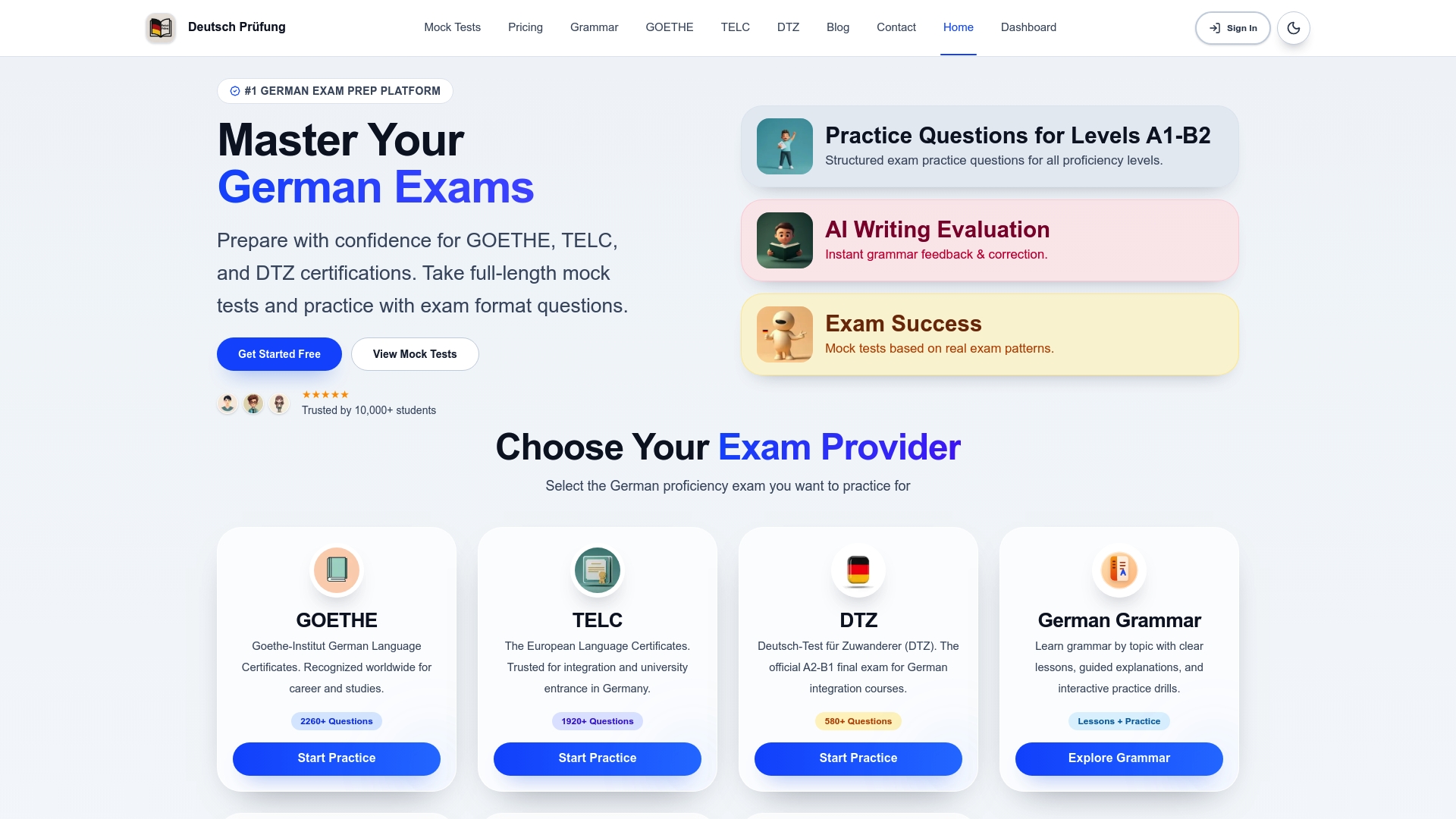
The platform provides full-length mock tests that simulate real exam conditions, helping you build stamina and manage time pressure effectively. AI-powered writing evaluation gives you instant feedback on your compositions, identifying grammatical errors and suggesting improvements. Audio exercises with native speakers train your ear for different accents and speaking speeds. Whether you’re starting at A1 or pushing toward B2 certification, you’ll find structured study plans that guide your preparation systematically. Track your progress with detailed analytics that show exactly where you need to focus your efforts. Start practicing today and transform your exam preparation from overwhelming to organized.
Frequently asked questions about German language exam questions
How many questions appear in typical German language exams?
Most German certification exams include 40-60 questions across all skill areas, though the exact number varies by level and exam type. Goethe B2 contains approximately 65 tasks across reading, listening, writing, and speaking. TELC B2 includes around 55-60 items. The speaking section typically involves 3-4 prompts rather than discrete questions.
What role does speaking versus writing play in final assessment?
Speaking and writing each typically account for 25% of your total score, with reading and listening comprising the other 50%. However, some exams weight skills differently. TELC’s modular approach means you must pass each skill section independently at 60%, while Goethe allows stronger skills to compensate for weaker ones as long as your overall score reaches 60%.
How can I overcome anxiety during oral exams?
Practice speaking out loud daily, even when alone, to build comfort with producing German spontaneously. Record yourself responding to prompts and listen back to normalize hearing your own voice. During the exam, take a deep breath before answering and remember that brief pauses to collect your thoughts are acceptable. Examiners evaluate your language skills, not your confidence level.
Where can I find free practice question banks?
Many official exam bodies provide sample questions on their websites. Goethe-Institut offers free model tests for each level. TELC publishes sample exams as PDF downloads. YouTube channels run by German teachers post practice questions with explanations. Public libraries often carry exam preparation books you can borrow at no cost.
What timing strategies work best during tests?
Divide your available time by the number of questions to establish a per-question time budget. For reading sections, spend 30 seconds scanning each text before reading questions, then locate answers efficiently. In writing tasks, allocate 25% of time for planning, 60% for writing, and 15% for review. Never leave questions blank; educated guesses score better than omissions.
Should I focus on one exam type or prepare broadly?
Focus on the specific exam you’ll take, as question formats and expectations differ significantly. Goethe preparation won’t fully prepare you for TELC’s practical scenarios, and vice versa. However, building core language skills through general practice benefits any exam. Once you’ve mastered fundamentals, dedicate the final 4-6 weeks exclusively to your target exam’s format.