

TL;DR:
- Exam formats and scoring vary, requiring targeted preparation for each certification.
- Official practice tests and understanding exam-specific rules boost chances of success.
- Passing depends on more than classroom ability; familiarity with test structure and scoring is essential.
Many learners assume that finishing a B1 textbook or scoring well in class automatically means they are ready to pass a German certification exam. That assumption leads to real surprises on test day. The CEFR framework (Common European Framework of Reference for Languages) defines levels from A1 through B2, but each official exam, whether Goethe, TELC, or DTZ, tests those levels in its own specific way, with its own timing, scoring rules, and passing thresholds. Understanding the difference between your general language ability and your certified exam readiness is the first step toward a confident result. This guide walks you through both.
Table of Contents
- What do the German language skills levels really mean?
- How are the main German exams structured? (Goethe, TELC, DTZ)
- Understanding the scoring: How is your German level certified?
- Strategies to prepare for the exam and maximize your certified skill level
- What most guides miss about language exams: A personal take
- Take the next step: Prepare smarter for your German exam
- Frequently asked questions
Key Takeaways
| Point | Details |
|---|---|
| Know your certification level | Understand what skills each German language level covers to target your preparation efficiently. |
| Match test to your needs | Compare exam formats to choose the right test for your learning style and background. |
| Focus your practice | Use detailed mock exams and skill-based strategies to maximize your certified score. |
| Score requirements matter | Passing thresholds and scoring schemes are different—knowing them avoids surprises on exam day. |
What do the German language skills levels really mean?
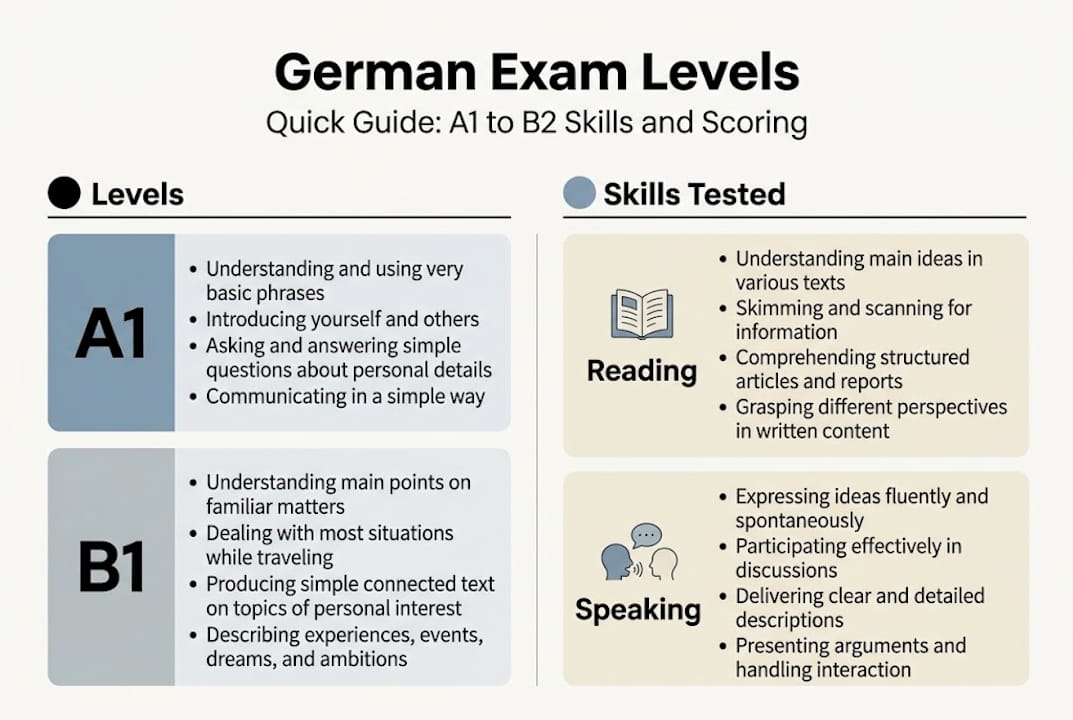
The CEFR organizes language ability into six levels, but for most German certification purposes, you will focus on A1 through B2. These are split into two broad categories: basic user (A1 and A2) and independent user (B1 and B2). Each level describes what you can actually do with the language, not just what grammar rules you have studied.
Here is a quick breakdown of what each level looks like in practice:
- 🟢 A1: You can introduce yourself, answer simple questions about personal details, and understand very slow, clear speech.
- 🟡 A2: You can handle routine tasks like shopping, asking for directions, and writing short personal messages.
- 🔵 B1: You can discuss familiar topics, describe experiences, and understand the main points of standard speech on everyday subjects.
- 🟣 B2: You can follow complex arguments, write detailed texts, and interact fluently with native speakers on a wide range of topics.
These descriptions sound clear, but here is where confusion creeps in. Your classroom level, your self-assessed level, and your certified exam level are three different things. A teacher might place you at B1 based on participation, but a formal exam measures specific skills under timed, standardized conditions.
| CEFR Level | Category | Key ability | Typical real-life scenario |
|---|---|---|---|
| A1 | Basic user | Introduce yourself | Filling out a simple form |
| A2 | Basic user | Handle routine exchanges | Buying a train ticket |
| B1 | Independent user | Discuss familiar topics | Talking with a colleague |
| B2 | Independent user | Argue and explain complex ideas | Reading a German newspaper |
Note on DTZ: The DTZ covers scaled A2/B1 and is especially designed for immigrants, meaning your final certified level depends on how many points you score, not just which level you attempted.
This distinction matters because it shapes your entire study approach. Comparing exam formats side by side, as covered in this German exam comparison, helps you see exactly which skills each test prioritizes.
How are the main German exams structured? (Goethe, TELC, DTZ)
Understanding what each level means helps, but how are these assessed in the main German exams? Each test has a distinct structure, and knowing that structure before you sit down to study saves you significant time.
| Exam | Skills tested | Written time | Oral section | Pass threshold | Retake policy |
|---|---|---|---|---|---|
| Goethe B1/B2 | Reading, Listening, Writing, Speaking | Varies by level and module | ~15 min | 60% per module | Modular retakes allowed |
| TELC B2 | Reading, Listening, Writing, Speaking | About 140 min | ~15 min | 60% overall | Check current provider and test-centre rules |
| DTZ | Reading, Listening, Writing, Speaking | 100 min | 15 min (pairs) | B1 in speaking plus one written component | Check current provider and test-centre rules |
Here is the typical component sequence for each exam:
Goethe B2:
- Lesen (Reading)
- Hören (Listening)
- Schreiben (Writing)
- Sprechen (Speaking, separate session)
TELC B2: The TELC B2 exam structure follows a similar four-skill format. The written portion runs 155 minutes total, covering reading comprehension, language elements, listening, and writing tasks. The oral section is conducted separately.

DTZ: The DTZ exam combines listening, reading, writing, and a pair-based oral section. The oral component is unique because you complete it with another candidate, which changes how you should practice speaking.
One standout feature worth noting: Goethe allows modular retakes. If you pass writing and reading but struggle with speaking, you can retake only the speaking module. TELC and DTZ do not offer this flexibility, so you must pass all sections in one sitting. For a detailed side-by-side view, check this guide on comparing TELC and Goethe exams.
Understanding the scoring: How is your German level certified?
Now that you know the structure, let’s dig into how your performance is actually measured and certified. Scoring rules vary by exam, and missing this detail is one of the most common reasons learners feel blindsided by their results.
| Exam | Total points | Pass cutoff | Certified level |
|---|---|---|---|
| Goethe B2 | 100 per module | 60% per module | B2 (or retake failed module) |
| TELC B2 | 300 total | 60% written + oral pass | B2 |
| DTZ | 100 total | B1 in speaking plus one written component | A2 or B1 based on score |
For TELC B2, the pass threshold is 60% across both written and oral sections. You cannot compensate a weak oral result with a strong written score. Both parts must meet the minimum standard independently.
For DTZ, Hören and Lesen are combined, while Schreiben and Sprechen are assessed separately. A B1 overall result requires B1 in speaking and B1 in at least one written component (Hören/Lesen or Schreiben). See the official g.a.s.t. scoring explanation for the current point bands.
Goethe modular retakes: Because Goethe allows you to retake individual modules, a candidate who passes three out of four components only needs to revisit the one weak area. This makes targeted preparation a genuinely practical strategy.
Pro Tip: Before your exam date, take at least two full mock tests under real timing conditions. This tells you exactly which sections are pulling your score down, so you can focus your final study weeks where they count most. You can also review TELC B2 writing scoring in detail to understand how written responses are evaluated.
If you narrowly miss the cutoff, do not panic. Most exam centers allow retakes within a few months, and a targeted review of your weak components often leads to a noticeably better result the second time.
Strategies to prepare for the exam and maximize your certified skill level
With a clear understanding of the scoring, you can now gear your preparation for the best possible outcome. General language study is helpful, but exam-specific preparation is what actually moves your score.
Step-by-step preparation approach:
- Identify your target exam and level. Choose between Goethe, TELC, or DTZ based on your purpose (immigration, career, or academic).
- Take a diagnostic mock test. This gives you a baseline score and shows which skill areas need the most attention.
- Study the exam format in detail. Know the timing, question types, and scoring rules before you practice.
- Work through official sample tests. These reflect the real exam more accurately than generic textbook exercises.
- Practice each skill component separately. Spend focused sessions on Lesen, Hören, Schreiben, and Sprechen.
- Simulate full exam conditions. At least twice before your test date, complete the entire exam within the official time limits.
Pro Tip: Most learners lose points not because they lack knowledge, but because they are unfamiliar with the question format. Spending 30 minutes studying how a specific question type is structured can save you more points than hours of general grammar review.
Recommended study resources:
- Official sample tests from Goethe Institut, TELC, or Bamf (for DTZ)
- Full-length mock exams with answer keys
- Grammar reference guides focused on B1 and B2 structures
- Audio exercises for Hören practice at your target level
- Speaking practice with a partner or tutor for DTZ pair tasks
For TELC B2 reading tips, targeted exercises help you manage the dense texts in the Lesen section efficiently. For the oral component, reviewing TELC B1 speaking strategies builds the confidence you need for pair-based tasks.
The Goethe modular retake option makes targeted preparation especially practical. If you know your writing is strong, you can invest more time in speaking without worrying about losing ground elsewhere. The TELC B2 written section runs about 140 minutes, so time management practice is not optional. It is essential.
What most guides miss about language exams: A personal take
Here is something worth saying plainly: finishing a B1 course does not mean you are ready to pass a B1 exam. These are genuinely different things, and most preparation guides gloss over that gap.
Each exam has its own logic. DTZ scales your result between A2 and B1 depending on your score, which is actually fairer than a hard pass/fail. Goethe lets you retake modules, which rewards consistent strong performance in some areas. TELC has strict timing and a firm 60% threshold across both written and oral sections. None of these quirks show up in a general language textbook.
We also see learners underestimate the psychological side of test day. Knowing the material is not the same as performing under timed, formal conditions. Anxiety, unfamiliar question formats, and poor time management account for a surprising share of failed attempts.
The real lesson is this: choosing the right exam for your situation matters as much as your language level. Match the exam to your goals, then prepare specifically for that exam’s format and scoring rules.
Take the next step: Prepare smarter for your German exam
Ready to boost your score with proven strategies and the right resources?
At Deutsch-Pruefung.de, you get access to full-length mock tests, official-style practice questions, and detailed preparation guides built specifically for TELC exam prep, Goethe exam prep, and DTZ practice materials. Every resource is aligned to the real exam format, so your practice time translates directly into better results. Whether you are targeting A1, B1, or B2, our structured plans and AI-powered writing feedback help you close the gap between where you are now and where you need to be. Start with a free trial and see the difference targeted preparation makes.
Frequently asked questions
What is the difference between A2, B1, and B2 German levels?
A2 is a basic user level covering routine exchanges, B1 is an independent user level for everyday communication, and B2 handles complex topics and detailed discussions. The DTZ certifies A2 or B1 depending on how many points you score.
Can I retake just one section of the Goethe or TELC exams?
Some modular Goethe and TELC examinations allow candidates to retake an individual part. The option and deadline depend on the exact examination and test centre, so confirm the current rules before registering.
How many points do I need to pass the TELC B2 exam?
You need at least 60% to pass the TELC B2 exam, and both the written and oral sections must independently meet this minimum.
Is the DTZ exam only for immigrants?
DTZ is the language examination used at the end of an integration course and reports performance at A2 or B1. Registration is handled through BAMF-authorized test centres, so candidates should confirm their eligibility with a local centre.
How are the DTZ test sections timed?
The DTZ written test lasts 100 minutes, and the oral section runs 15 minutes and is completed in pairs with another candidate.