
If you’ve started exploring German language exams, you’ve likely encountered a confusing array of certification names: GOETHE, TELC, DTZ, and more. Many learners struggle to understand what these certificates actually prove, which exam suits their goals, and how to prepare effectively. This guide clarifies the core differences between the main German language certificates for levels A1 to B2, explains what each certification accomplishes, and provides actionable strategies to help you choose the right exam and prepare with confidence for your academic, professional, or integration objectives.
Table of Contents
- Key takeaways
- Understanding what a language certificate is
- Comparing the main German language certificates: GOETHE, TELC, and DTZ
- How to prepare effectively for German language certificates at levels A1 to B2
- Choosing the right certificate for your goals: academic, integration, or professional focus
- Explore trusted resources to start your German certification journey
- Frequently asked questions
Key Takeaways
| Point | Details |
|---|---|
| Exam purposes | Learn what each certificate proves and who uses it to guide your selection. |
| CEFR levels A1 B2 | CEFR levels A1 through B2 are covered by these main certificates, spanning basic survival to independent professional use. |
| GOETHE advantages | GOETHE is strongest for academic recognition and offers modular retakes starting at B1 to retake only failed sections. |
| TELC features | TELC emphasizes practical European communication and includes a paired speaking component to simulate real conversations. |
| DTZ focus | DTZ focuses on integration needs and is not typically accepted for university admission. |
Understanding what a language certificate is
A language certificate is an official document that verifies your proficiency in a foreign language at a specific level according to standardized criteria. These certificates serve multiple critical purposes in modern life. Employers use them to assess communication abilities for international positions. Universities require them as proof of language competence for admission. Immigration authorities demand them for residency and citizenship applications. Personal learners pursue them to validate achievement and set clear learning milestones.
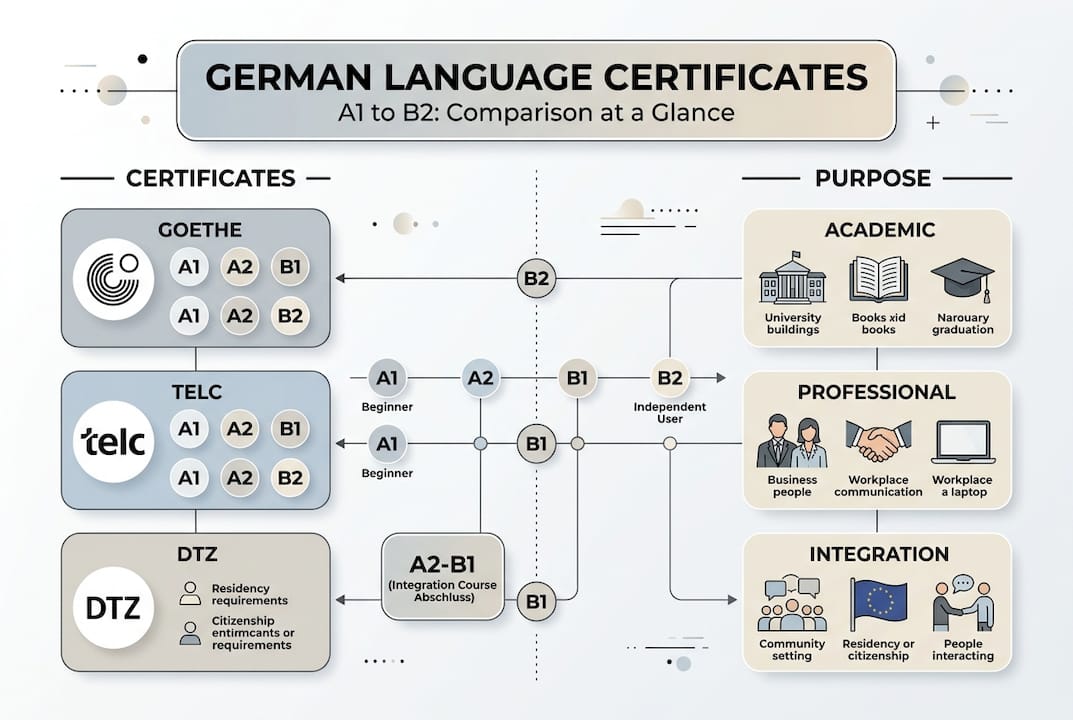
German language certificates follow the Common European Framework of Reference for Languages (CEFR), which defines six proficiency levels from A1 (beginner) to C2 (mastery). For most practical purposes, levels A1 through B2 cover the spectrum from basic survival communication to independent, fluent interaction in everyday and professional contexts. The three main German certificates are GOETHE for academic recognition, TELC for practical European contexts, and DTZ for integration purposes, each serving distinct audiences and objectives.
Understanding these distinctions prevents costly mistakes. A DTZ certificate won’t help with university admission. A GOETHE certificate may be unnecessary if you only need proof of language skills for a work visa. Choosing the wrong exam wastes time, money, and effort on preparation that doesn’t align with your actual needs.
Pro Tip: Before registering for any exam, verify which specific certificate your target institution or immigration authority accepts. Recognition varies significantly by country and purpose.
The certificate you earn becomes part of your permanent credentials. It demonstrates not just language ability but also commitment, discipline, and cultural competence. For career advancement, academic opportunities, or building a new life in a German-speaking country, the right certificate opens doors that remain closed to those without formal verification of their skills.
Comparing the main German language certificates: GOETHE, TELC, and DTZ
The German language certification landscape includes three primary options, each designed for different contexts and offering unique advantages. Understanding these differences helps you invest your preparation time wisely and select the exam that truly serves your objectives.

GOETHE certificates enjoy the strongest global recognition, particularly in academic settings. Universities worldwide accept GOETHE certification as proof of German proficiency for admission. The exam emphasizes formal language competence and cultural knowledge. Starting at B1 level, GOETHE offers modular retakes, allowing you to repeat only the sections where you didn’t pass rather than retaking the entire exam. This flexibility reduces stress and cost for learners who excel in some skills but need additional work in others.
TELC certifications target practical communication in European professional and everyday contexts. The exam format includes a distinctive paired speaking component where two candidates interact with each other, simulating real conversational dynamics. This approach tests authentic communication ability rather than just responding to examiner prompts. TELC certificates are widely accepted by employers across Europe and meet requirements for many work visa applications. The practical orientation makes TELC ideal if your primary goal involves employment or daily life integration rather than academic study.
DTZ (Deutsch-Test für Zuwanderer) serves a specialized purpose: integration and residency in Germany. Immigration authorities recognize DTZ as proof of language competence for permanent residency and citizenship applications. However, DTZ lacks recognition for university admission, making it unsuitable if you plan to pursue higher education. The exam focuses heavily on everyday communication scenarios relevant to living and working in Germany.
| Certificate | Primary Purpose | Recognition Scope | Levels Available | Unique Features |
|---|---|---|---|---|
| GOETHE | Academic admission, global recognition | Worldwide universities, cultural institutions | A1 to C2 | Modular retakes at B1+, youth versions, special needs accommodations |
| TELC | Professional employment, European contexts | European employers, work visas | A1 to C2 | Paired speaking exam, practical scenarios |
| DTZ | Integration, residency applications | German immigration authorities | A2 to B1 | Integration-focused content, not for university |
All three certification bodies offer youth versions and special accommodations for test takers with disabilities or learning differences. These adaptations ensure fair assessment while maintaining standardized proficiency benchmarks.
Pro Tip: Research the specific exam format for your chosen certificate. TELC’s paired speaking requires different preparation strategies than GOETHE’s individual speaking assessment.
How to prepare effectively for German language certificates at levels A1 to B2
Successful certification requires more than general language study. You need targeted preparation that addresses the specific format, timing, and assessment criteria of your chosen exam. Strategic preparation maximizes your score and builds the confidence necessary to perform well under test conditions.
Start by thoroughly understanding your exam’s structure. Each certificate tests four skills: reading, writing, listening, and speaking. However, the weighting, question types, and time limits vary. GOETHE exams typically separate skills into distinct sections with specific time allocations. TELC integrates skills more fluidly. DTZ emphasizes practical communication scenarios. Download official sample exams and study the format until it becomes completely familiar.
For GOETHE candidates at B1 or higher, leverage the modular retake option strategically. If you excel in reading and listening but struggle with writing, focus your preparation energy on the weaker skill. You can retake only the sections you didn’t pass, saving time and registration fees. This targeted approach often proves more effective than spreading effort equally across all skills.
TELC test takers must prepare specifically for paired speaking interactions. Practice with a study partner to develop natural turn-taking, active listening, and collaborative communication. The paired format rewards candidates who can negotiate meaning, ask clarifying questions, and build on their partner’s contributions rather than simply delivering prepared monologues.
Follow this preparation sequence for optimal results:
- Take a diagnostic practice exam to identify your current level and weak areas
- Create a study schedule allocating more time to weaker skills while maintaining stronger ones
- Use official preparation materials that match your exam’s format and difficulty
- Practice under timed conditions to build stamina and time management skills
- Record yourself speaking and writing to identify patterns in your errors
- Take full-length simulated exams weekly in the month before your test date
Pro Tip: Regular simulated exams reduce test anxiety and improve time management more effectively than any other preparation strategy. Treat practice tests like the real exam: no pauses, no looking up answers, strict time limits.
Consistent, focused practice builds the automaticity necessary for confident performance. Students who practice exam formats regularly outperform those with stronger general language skills but less exam-specific preparation.
Develop a balanced study routine that addresses all four skills daily. Spend 40% of your time on weaker areas, 30% maintaining strong skills, and 30% on integrated practice that combines multiple skills. This distribution prevents skill atrophy while accelerating improvement in challenging areas. Use authentic materials like news articles, podcasts, and videos to build vocabulary and cultural knowledge that enriches your exam responses.
Choosing the right certificate for your goals: academic, integration, or professional focus
Your certification choice should align precisely with your objectives. The wrong certificate creates obstacles; the right one accelerates your progress toward specific goals. Consider these common motivations for certification and which exam serves each purpose best.
Academic goals require certificates with university recognition. If you plan to study at a German university or any institution requiring German language proficiency, GOETHE offers the strongest global academic recognition. Most universities specify GOETHE certification in their admission requirements. Some accept TELC for certain programs, but verification is essential. DTZ never satisfies university language requirements.
Professional objectives vary by industry and location. For employment in German-speaking countries, TELC provides practical, work-focused certification that employers recognize and value. The exam’s emphasis on real-world communication demonstrates job-relevant skills. GOETHE also enjoys strong professional recognition, particularly for positions requiring cultural knowledge or academic credentials. Check specific job postings or employer requirements to confirm which certificate they prefer.
Integration and residency purposes have clear requirements. German immigration authorities specify DTZ as the appropriate integration certificate for permanent residency and citizenship applications. While GOETHE and TELC also meet these requirements at equivalent levels, DTZ costs less and focuses specifically on integration scenarios. If your only goal is residency qualification, DTZ provides the most efficient path.
| Goal | Best Certificate Choice | Key Considerations |
|---|---|---|
| University admission | GOETHE | Verify specific institution requirements, consider level needed (usually B2 or C1) |
| Professional employment | TELC or GOETHE | Check employer preferences, consider industry norms |
| Integration/residency | DTZ or TELC | Confirm immigration authority requirements, DTZ most cost-effective |
| Personal achievement | Any certificate | Choose based on format preference and availability |
Some learners have multiple goals. If you need certification for both university admission and residency, GOETHE satisfies both requirements. If you want professional credentials that also support immigration applications, TELC serves dual purposes effectively. Avoid taking multiple exams unless absolutely necessary.
Pro Tip: Contact your target institution or immigration office directly to confirm current certificate requirements. Policies change, and official confirmation prevents preparation for the wrong exam.
Consider practical factors beyond recognition. Exam availability varies by location. GOETHE institutes operate worldwide, making their exams accessible internationally. TELC has strong European presence but fewer centers in some regions. DTZ is primarily available in Germany. Registration costs differ, with DTZ typically the least expensive option. Factor in travel, preparation materials, and potential retake costs when budgeting for certification.
Explore trusted resources to start your German certification journey
Understanding German language certificates is the first step. Translating that knowledge into exam success requires comprehensive preparation resources, structured practice, and expert guidance tailored to your specific certification goal.
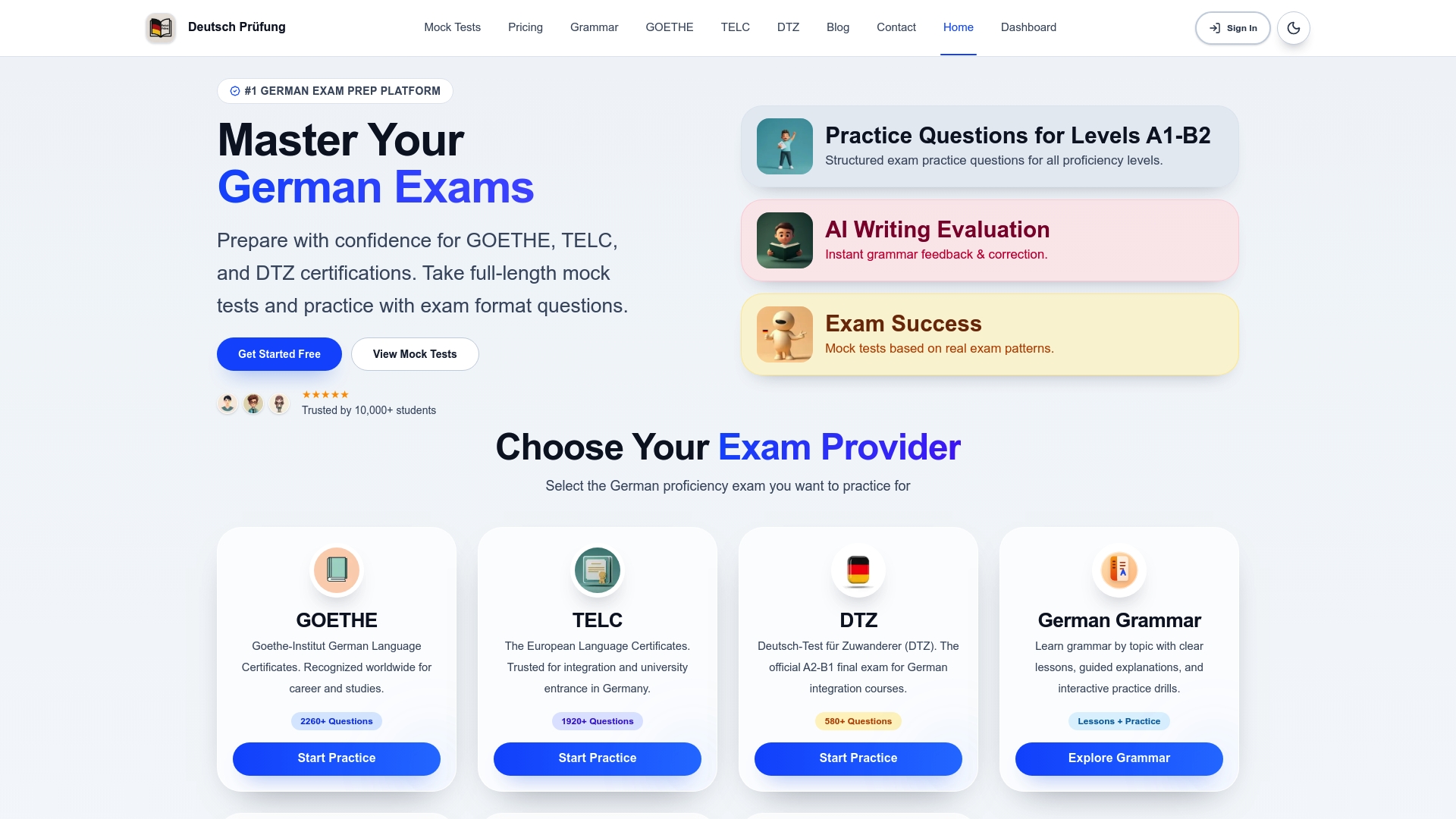
Deutsch-Pruefung.de provides everything you need to prepare effectively for GOETHE, TELC, and DTZ exams at levels A1 through B2. The platform offers full-length mock tests that simulate real exam conditions, helping you build familiarity and confidence. AI-powered writing evaluation gives you instant feedback on your compositions, identifying specific areas for improvement. Audio exercises develop listening comprehension with exam-relevant content.
Whether you’re pursuing academic admission, professional advancement, or integration goals, the right preparation platform transforms uncertainty into confident readiness. Access structured practice questions, official exam patterns, and expert strategy tips that address the specific requirements of your chosen certificate. Start your preparation journey with resources designed by language professionals who understand exactly what each exam demands.
Frequently asked questions
What is a language certificate?
A language certificate is an official document issued by a recognized testing organization that verifies your proficiency in a foreign language at a specific level according to standardized criteria like the CEFR. It serves as proof of language ability for educational institutions, employers, and immigration authorities.
Which German certificate should I choose for university admission?
GOETHE certificates offer the strongest recognition for university admission worldwide. Most German universities and international institutions requiring German proficiency specify GOETHE certification in their admission requirements. Verify your target institution’s specific requirements before registering.
How long does it take to prepare for a B1 German exam?
Preparation time varies based on your starting level, study intensity, and prior language experience. Most learners need 200 to 300 hours of study to progress from A2 to B1 level. With focused daily practice, this typically requires 3 to 6 months of preparation.
Can I retake only failed sections of a German language exam?
GOETHE exams offer modular retakes starting at B1 level, allowing you to repeat only the sections you didn’t pass. TELC and DTZ require complete exam retakes if you don’t achieve the overall passing score. This makes GOETHE more flexible for candidates with uneven skill development.
Does DTZ certification work for job applications in Germany?
DTZ primarily serves integration and residency purposes rather than professional credentialing. While it demonstrates basic German communication ability, employers typically prefer TELC or GOETHE certificates that assess broader language competence. For professional positions, choose TELC or GOETHE rather than DTZ.