

TL;DR:
- B2 German is an independent user level, enabling effective conversation and comprehension in real-world situations.
- It involves reading complex texts, holding spontaneous discussions, and writing detailed texts without native fluency.
- B2 certification is crucial for university admission, employment, and immigration in German-speaking countries.
Many learners assume that reaching B2 level German means speaking like a native. It doesn’t. B2 is the “independent user” level on the international language scale, meaning you can handle real conversations, read complex texts, and express yourself clearly without constant support. That’s genuinely impressive, and it opens real doors: university admissions, work visas, job contracts, and life in German-speaking countries. But it’s not the same as native fluency, and confusing the two can leave you either overconfident or unnecessarily discouraged. Understanding exactly what B2 means gives you a realistic target and a smarter path to certification.
Table of Contents
- What does B2 level German mean?
- The four language skills at B2 level
- Why is B2 important for work, study, and immigration?
- How to prepare for B2 level German exams
- Why B2 isn’t the finish line—and what most learners miss
- Ready to prove your B2 German skills?
- Frequently asked questions
Key Takeaways
| Point | Details |
|---|---|
| B2 is independent user | At B2, you can handle most German conversations and work tasks without needing constant support. |
| Real-world value | B2 certification opens doors for study, career, and immigration in German-speaking countries. |
| Balanced skill set | You’ll need to master reading, writing, listening, and speaking for B2 exams and daily life. |
| Preparation is key | Success at B2 demands consistent practice and simulated exam conditions. |
What does B2 level German mean?
Now that we’ve seen why knowing the correct definition matters, let’s dig into what B2 actually represents according to global standards.
The CEFR framework (Common European Framework of Reference for Languages) is the standard used across Europe and beyond to measure language proficiency. It divides learners into six levels: A1, A2, B1, B2, C1, and C2. CEFR levels are the recognized benchmark for language proficiency across Europe, used by schools, employers, and immigration authorities alike.
B2 sits in the upper-intermediate range. You’re no longer a beginner struggling with basic phrases, and you’re not yet at the advanced level where you can handle every nuance of the language. You’re an independent user. That means you can function confidently in most everyday and professional situations.
Here’s what B2 level German actually looks like in practice:
- 📖 You can read and understand the main ideas in complex texts, including technical articles in your own field
- 🗣️ You can hold conversations with native speakers without either side needing to strain or simplify excessively
- ✍️ You can write clear, detailed texts on a wide range of subjects
- 👂 You can follow extended speech and lectures, even when the content is not clearly structured
- 💡 You can explain your viewpoint on a topic and discuss the advantages and disadvantages of different options
How does B2 compare to neighboring levels?
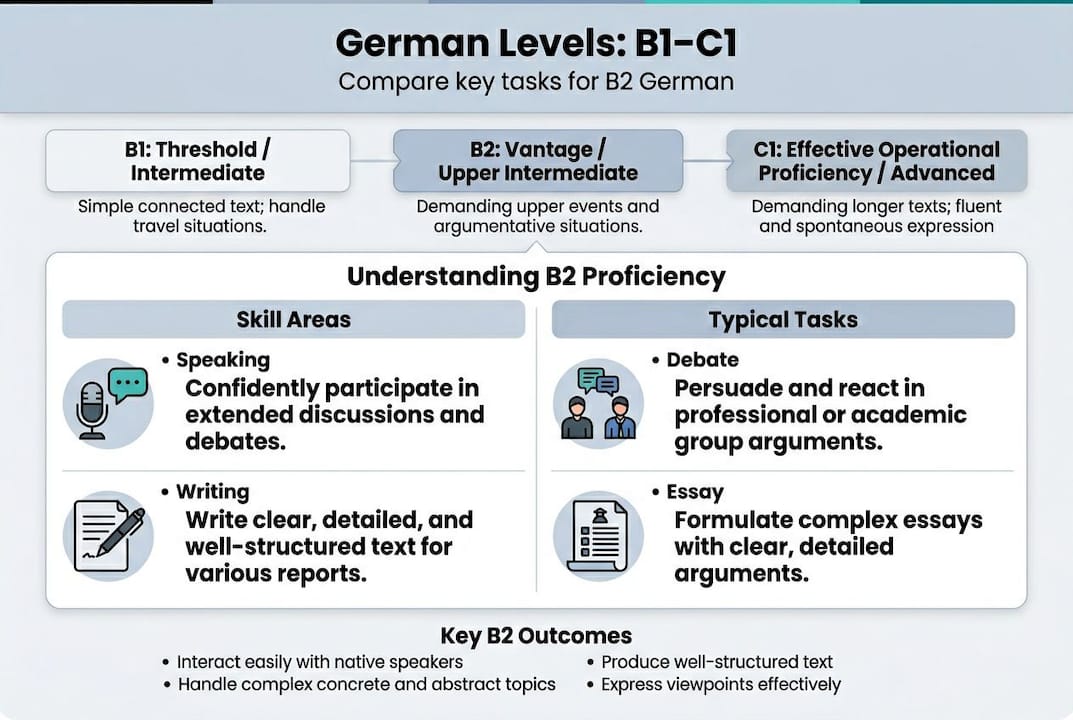
| Level | Label | What you can do |
|---|---|---|
| B1 | Threshold | Handle familiar topics; basic travel and work situations |
| B2 | Independent | Handle complex texts; interact spontaneously; argue a position |
| C1 | Proficient | Understand implicit meanings; use language flexibly and effectively |
B1 learners often need support or repetition in unfamiliar situations. C1 learners move through complex topics with ease. B2 is the sweet spot where you’re genuinely functional but still building toward full command of the language.
“B2 is not about sounding perfect. It’s about communicating effectively and independently in most real-world situations.”
If you’re also thinking about German test levels for immigration, B2 is often the threshold that matters most for visa and residency applications.
Pro Tip: Don’t chase perfection at B2. Focus on clear, functional communication. Examiners reward accuracy and coherence, not flawless native-like speech.
The four language skills at B2 level
With a solid grasp of the definition, we can now look at the practical language skills you’ll need to demonstrate at this level.
Every B2 exam, whether it’s the Goethe B2 exam or the TELC B2, tests four core skills: Lesen (reading), Hören (listening), Schreiben (writing), and Sprechen (speaking). According to CEFR descriptors, B2 candidates should interact with relative fluency and spontaneity. Here’s what that means for each skill.

1. Lesen (Reading) You read articles, reports, and literary texts. You identify the main argument, distinguish facts from opinions, and understand implied meaning. This isn’t skimming headlines; it’s genuine comprehension of structured, nuanced content.
2. Hören (Listening) You follow radio programs, podcasts, and presentations on familiar and unfamiliar topics. You catch the speaker’s attitude and purpose, not just the surface-level information.
3. Schreiben (Writing) You write formal letters, essays, and reports. You can argue a position, summarize information, and structure your ideas logically. Check out B2 writing strategies to sharpen this skill before your exam.
4. Sprechen (Speaking) You participate in discussions, defend your viewpoint, and negotiate meaning. You handle unexpected questions without falling apart. For targeted practice, B2 speaking tips can help you build confidence in real exam conditions.
How task difficulty scales across levels:
| Skill | B1 task | B2 task | C1 task |
|---|---|---|---|
| Speaking | Describe a photo | Debate a social issue | Discuss abstract concepts fluently |
| Writing | Write a short message | Write a formal complaint letter | Write a nuanced analytical essay |
| Reading | Understand simple news | Analyze a complex article | Interpret implicit meaning in literature |
| Listening | Follow slow, clear speech | Follow a lecture with some complexity | Understand fast, idiomatic native speech |
For real-life B2 language examples that mirror actual exam tasks, practice with content that reflects authentic German communication.
Pro Tip: Don’t practice skills in isolation. Combine reading and writing by summarizing an article you just read. Combine listening and speaking by responding aloud to a podcast. Integrated practice builds the kind of flexible thinking B2 exams reward.
Why is B2 important for work, study, and immigration?
Understanding the skills is useful, but where does B2 really matter in the real world? Let’s see why this level is a game changer for so many learners.
B2 German isn’t just a certificate to hang on your wall. It’s a functional credential that unlocks specific opportunities in German-speaking countries. B2 is commonly requested for academic admissions and work authorization in German-speaking regions, making it one of the most practically valuable language milestones you can reach.
Here’s where B2 certification makes a direct difference:
- 🎓 University admissions: Many German and Austrian universities require B2 or higher for degree programs taught in German. Without it, your application may not even be considered.
- 💼 Employment: Employers in sectors like healthcare, engineering, education, and logistics often list B2 as a minimum language requirement. It signals that you can communicate with colleagues, read contracts, and handle professional correspondence.
- 🛂 Visa and residency: Several German visa categories, including the skilled worker visa and certain family reunification pathways, require documented B2 proficiency. See the full picture of German test requirements for immigration.
- 🏥 Regulated professions: Doctors, nurses, and other licensed professionals working in Germany are typically required to demonstrate B2 or C1 proficiency before receiving professional recognition.
“B2 is the point where German stops being a subject you study and starts being a tool you use.”
The Goethe B2 certification is recognized internationally and accepted by most German institutions as proof of this level. TELC B2 is another widely accepted option, particularly for immigration and employment purposes.
Beyond the paperwork, B2 proficiency means you can attend a job interview in German, understand your rental contract, follow a university lecture, and handle a disagreement with a landlord. These are real-life situations where the certificate translates into actual capability.
How to prepare for B2 level German exams
Knowing why B2 matters, it’s time to focus on how you can actually reach and prove your skills at this level.
Mock exams and focused practice greatly improve B2 exam performance, and the most successful candidates treat preparation as a structured process, not just casual review.
Step-by-step B2 exam prep plan:
- Assess your current level. Take a diagnostic test to identify your weakest skills. Don’t assume you know where the gaps are.
- Build a study schedule. Aim for consistent daily practice over several months rather than cramming. Spread your time across all four skills.
- Use official practice materials. Work with real past papers and exam-format questions. The TELC B2 exam and Goethe B2 each have specific formats you need to know inside out.
- Practice under timed conditions. Simulate the actual exam environment. Time pressure changes everything, and you need to be comfortable with it before exam day.
- Get feedback on your writing and speaking. These two skills are the hardest to self-assess. Use a tutor, a language partner, or an AI-powered evaluation tool.
- Review your mistakes systematically. Don’t just note what you got wrong. Understand why, and revisit that area a week later to confirm you’ve retained the correction.
Common mistakes to avoid:
- Focusing only on grammar drills while neglecting listening and speaking
- Skipping timed practice until the week before the exam
- Underestimating the writing section, especially formal letter formats
- Ignoring the specific exam format for your chosen test
For targeted strategies, the Goethe B2 exam guide and TELC B2 advice walk you through the exact format, scoring, and preparation approach for each exam. Use the right guide for the right test.
Pro Tip: Take at least two full-length mock exams before your real test. Simulated exam conditions, including timing and silence, train your brain to perform under pressure. Candidates who skip this step often underperform despite knowing the material.
Why B2 isn’t the finish line—and what most learners miss
With all the technical knowledge covered, let’s step back and consider what B2 level German really means on your lifelong learning path.
Here’s something most prep guides won’t tell you: passing B2 can actually slow your progress if you’re not careful. Many learners reach B2, celebrate (rightfully), and then stop pushing themselves. They use German in controlled, familiar settings and avoid situations that feel risky or uncomfortable. Within months, the growth stalls.
B2 gives you independence, not fluency. You can navigate Germany. You can hold a job. But you’ll still encounter fast-paced native conversations, regional dialects, and cultural references that leave you momentarily lost. That’s normal. The mistake is treating those moments as evidence that B2 wasn’t enough, rather than as the next learning opportunity.
The learners who keep advancing after B2 are the ones who deliberately seek out discomfort. They watch German TV without subtitles. They join local clubs where they’re the only non-native speaker. They read novels, not just news articles. They use practical German language examples to keep stretching beyond their comfort zone.
Think of B2 as a launchpad. The certification proves you’re ready to operate independently. What you do with that independence determines whether your German keeps growing or quietly fades.
Ready to prove your B2 German skills?
If you’re committed to validating your B2 skills, the right resources can make all the difference.
At Deutsch-Pruefung.de, we’ve built everything you need to prepare with confidence. Whether you’re targeting the Goethe B2 or TELC B2, our structured guides walk you through every section of the exam with clarity and precision.
Start with the Goethe B2 guide or the TELC B2 guide to understand the exact format, scoring criteria, and skill requirements for your chosen exam. Then put your knowledge to the test with our full-length B2 mock tests, designed to replicate real exam conditions so you walk in prepared, not surprised. Your B2 certification is within reach.
Frequently asked questions
Is B2 level German considered fluent?
B2 users can interact with fluency and spontaneity but may still find native-level complex language challenging. B2 is classified as independent user level, which is strong and functional but not the same as native fluency.
What kinds of jobs can I get with B2 German?
B2 is used as a hiring minimum in many German workplaces, making it suitable for professional roles in healthcare, logistics, education, and customer-facing positions where clear communication matters more than native-level precision.
How long does it take to reach B2 German?
Reaching B2 typically requires 600 to 800 hours of guided study, though the timeline varies based on your native language, prior exposure to German, and how intensively you practice.
What are the main differences between B2 and C1 German?
C1 is a proficient user who understands implicit meanings and handles complex subjects with ease, while B2 users are comfortable and independent but may need additional context or support with highly advanced content.