

TL;DR:
- The Goethe exam is a rigorous, internationally recognized certification focused on real-life language skills.
- It offers levels from A1 to B2, aligned with the CEFR, for academic, professional, and immigration purposes.
- Success requires targeted practice in listening, reading, writing, and speaking, emphasizing exam format mastery.
Many learners assume all German language exams are basically the same. They are not. The Goethe exam stands apart because of its rigorous skill-based structure, its direct relevance to real-life language use, and the fact that its internationally recognized certificates are accepted for university admission, employment, and immigration applications worldwide. Whether you are a beginner aiming for A1 or an advanced learner targeting B2, understanding how this exam works gives you a real edge. This guide walks you through the exam’s purpose, level structure, tested skills, and the strategies that actually move the needle.
Table of Contents
- Goethe exam overview: Purpose and global recognition
- Exam levels and certificates: A1 to B2 explained
- Skills tested in the Goethe exam: Structure and task types
- Goethe exam vs. other German tests: How it compares
- Our take: Getting real results from Goethe exam prep
- Optimize your Goethe exam prep with targeted resources
- Frequently asked questions
Key Takeaways
| Point | Details |
|---|---|
| Global recognition | Goethe exam certificates are accepted by universities, employers, and immigration offices worldwide. |
| Skill-based assessment | The exam evaluates listening, reading, writing, and speaking through real-life scenarios. |
| Multiple levels | Candidates choose from A1 to B2 levels, each targeting a different proficiency and purpose. |
| Comparative options | Other exams like TELC also certify German skills but differ in format and focus. |
| Preparation resources | Practice tests and targeted guides boost your odds of success in the Goethe exam. |
Goethe exam overview: Purpose and global recognition
The Goethe exam, administered by the Goethe-Institut, is one of the most widely respected standardized tests for German language proficiency. It is not just a school certificate. It is an internationally accepted credential that opens real doors.
Who actually needs this exam? The answer covers a wider group than most people expect:
- 🎓 Students applying to German-speaking universities who need to prove language competence
- 💼 Job seekers targeting employers in Germany, Austria, or Switzerland who require certified language skills
- 🌍 Immigrants and visa applicants who must demonstrate German proficiency as part of residency or family reunification requirements
- 📚 Language learners who want a formal, internationally recognized record of their progress
The exam’s global reach is significant. Goethe-Institut operates in over 90 countries, meaning you can sit the exam close to home regardless of where you live. That accessibility matters when you are planning around visa deadlines or university application windows.
“Certifying German skills through the Goethe exam unlocks study, work, and immigration pathways that would otherwise require lengthy additional documentation.”
What makes the Goethe exam particularly valuable is that it is not tied to any single country’s curriculum. It follows the Common European Framework of Reference for Languages (CEFR), which means your certificate carries the same weight whether you earned it in Brazil, Japan, or the United States. Employers and institutions across Europe and beyond understand exactly what each level means.
For Goethe exam practice and targeted preparation, starting with a clear understanding of the exam’s purpose helps you stay motivated. You are not just studying grammar rules. You are building a credential with real-world applications.
One often-overlooked point: the Goethe exam is designed for adult learners and older teenagers, with age-appropriate content and scenarios. This makes it distinct from school-based tests and more relevant to the real communication situations you will face in professional or academic settings.
Exam levels and certificates: A1 to B2 explained
Knowing the exam’s purpose is only half the picture. Choosing the right level is where your preparation strategy begins. The Goethe exam follows the CEFR framework, offering certificates from A1 (absolute beginner) through B2 (upper-intermediate). Each level has distinct skill requirements and serves a specific purpose.
| Level | Label | Typical use case |
|---|---|---|
| A1 | Beginner | Family reunification visa, basic daily communication |
| A2 | Elementary | Entry-level work permits, basic social interaction |
| B1 | Intermediate | Permanent residency, broader employment opportunities |
| B2 | Upper-intermediate | University admission, professional roles, advanced study |
According to German exam levels, each certificate is designed with specific skill benchmarks that reflect real communication demands at that stage.
Here is a quick breakdown of what each level actually expects from you:
- A1: Understand and use familiar everyday expressions; introduce yourself and others; ask and answer basic personal questions
- A2: Communicate in simple, routine tasks; describe your background, immediate environment, and immediate needs
- B1: Handle most situations while traveling in a German-speaking area; produce simple connected text on familiar topics; describe experiences and briefly explain opinions
- B2: Understand the main ideas of complex text on both concrete and abstract topics; interact with fluency and spontaneity; produce clear, detailed text on a wide range of subjects
Choosing the wrong level is a common and costly mistake. Aiming too high without adequate preparation leads to failure and wasted exam fees. Aiming too low means your certificate may not meet the requirements of your target university or visa category. Review the German language credentials required for your specific goal before registering.
Pro Tip: If you are unsure which level fits you, take a free placement test online before committing to registration. Many learners overestimate their level after casual study and underestimate the structured demands of a formal exam. Also check the Goethe vs TELC comparison to confirm Goethe is the right exam family for your needs.
Skills tested in the Goethe exam: Structure and task types
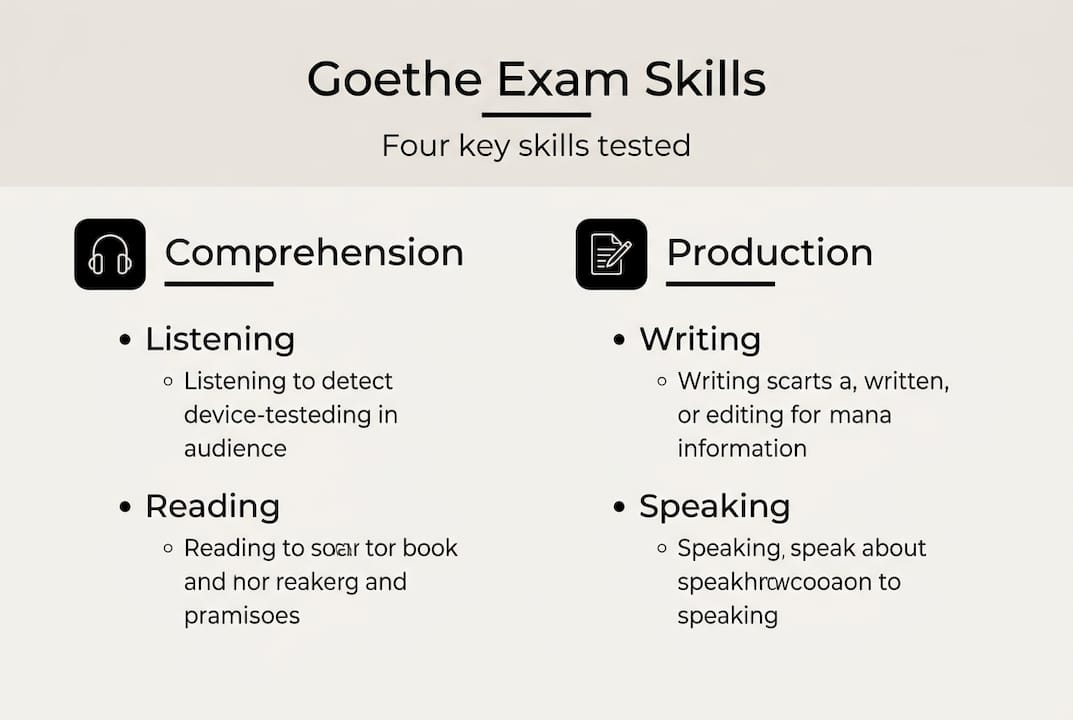
Preparing strategically means knowing exactly what the exam measures. The Goethe exam tests four core skills: listening (Hören), reading (Lesen), writing (Schreiben), and speaking (Sprechen). Each section uses task types designed around real-life scenarios, not abstract grammar exercises.

Here is how each skill section is structured:
| Skill | Section name | Typical task types |
|---|---|---|
| Listening | Hören | Multiple choice, true/false, gap fill based on audio clips |
| Reading | Lesen | Matching, multiple choice, short answer based on written texts |
| Writing | Schreiben | Short messages, form completion, short essays or letters |
| Speaking | Sprechen | Self-introduction, picture description, role-play, discussion |
The tasks are built around everyday situations: reading a notice at work, listening to a voicemail, writing an email to a neighbor, or discussing a topic with a partner. This is not accidental. The Goethe exam is designed to measure practical communication ability, not just textbook knowledge.
Here is a numbered breakdown of how to approach each skill strategically:
- Hören (listening): Practice with authentic German audio at your target level. Focus on catching key words and context clues rather than understanding every word.
- Lesen (reading): Build speed by reading short German texts daily. Scan for main ideas first, then read for detail.
- Schreiben (writing): Practice structured responses. Learn standard phrases for formal and informal writing at your level.
- Sprechen (speaking): Record yourself answering common B2 speaking tasks or practice with a language partner. Fluency matters more than perfection.
Pro Tip: The speaking section makes most candidates nervous. But examiners are not looking for flawless grammar. They want to see that you can communicate your ideas clearly and respond naturally. Practicing with timed mock tasks reduces anxiety more than any grammar drill.
For German exam question examples across all four skills, reviewing real task formats before exam day removes the element of surprise and sharpens your response speed.
Goethe exam vs. other German tests: How it compares
The Goethe exam is not the only game in town. TELC (The European Language Certificates) is another widely recognized option, and understanding the differences helps you make a smarter choice for your specific situation.
| Feature | Goethe exam | TELC exam |
|---|---|---|
| Administered by | Goethe-Institut | TELC GmbH |
| Levels available | A1 to C2 | A1 to C1 |
| Focus | Communicative competence | Broader language skills |
| International recognition | Very high | High, especially in Europe |
| Test centers | 90+ countries | Primarily Europe |
| Preparation style | Task-based, real-world scenarios | Mix of task-based and formal |
Both exams are valid for language certification, but key differences in test style mean one may suit your goals better than the other.
Here is when Goethe tends to be the stronger choice:
- University admission outside Europe: Many non-European institutions specifically name the Goethe certificate as an accepted credential
- Immigration to Germany: German embassies frequently list Goethe A1 as the required standard for family reunification visas
- Learners outside Europe: With test centers in over 90 countries, access is significantly broader
Here is when TELC may be a better fit:
- You are based in Europe and have easy access to TELC centers
- Your target employer or institution accepts either exam and TELC prep resources are more available to you
- You prefer the TELC exam format after reviewing sample tests
For TELC exam practice alongside Goethe preparation, comparing sample tests from both providers is the most reliable way to decide. The format you find more intuitive will likely produce better results under exam pressure.
One practical note: some learners prepare for both exams simultaneously since the core language skills overlap heavily. The main adjustment is adapting to each exam’s specific task formats and timing.
Our take: Getting real results from Goethe exam prep
Here is something experienced educators see repeatedly: learners spend 80% of their study time on grammar drills and only 20% on actual exam tasks. That ratio needs to flip.
Grammar knowledge is necessary, but the Goethe exam rewards applied communication. You can know every rule and still freeze during the Sprechen section because you have never practiced speaking under timed conditions. The Goethe exam strategy that consistently produces results is simple: simulate the real exam as often as possible.
Most people also underestimate how much the oral exam format affects performance. Speaking to an examiner or a partner in a structured task feels completely different from chatting casually. Practicing with peers, recording your responses, and reviewing them critically builds the kind of confidence that grammar books cannot.
The biggest mindset shift? Stop trying to master the language perfectly before exam day. Focus on mastering the format. Knowing how to structure a written response, how to manage your time in the reading section, and how to recover when you lose your train of thought in speaking, these are the skills that separate passing candidates from failing ones.
Optimize your Goethe exam prep with targeted resources
You now have a clear picture of the Goethe exam’s structure, levels, and tested skills. The next step is putting that knowledge into practice with resources built specifically for exam success.
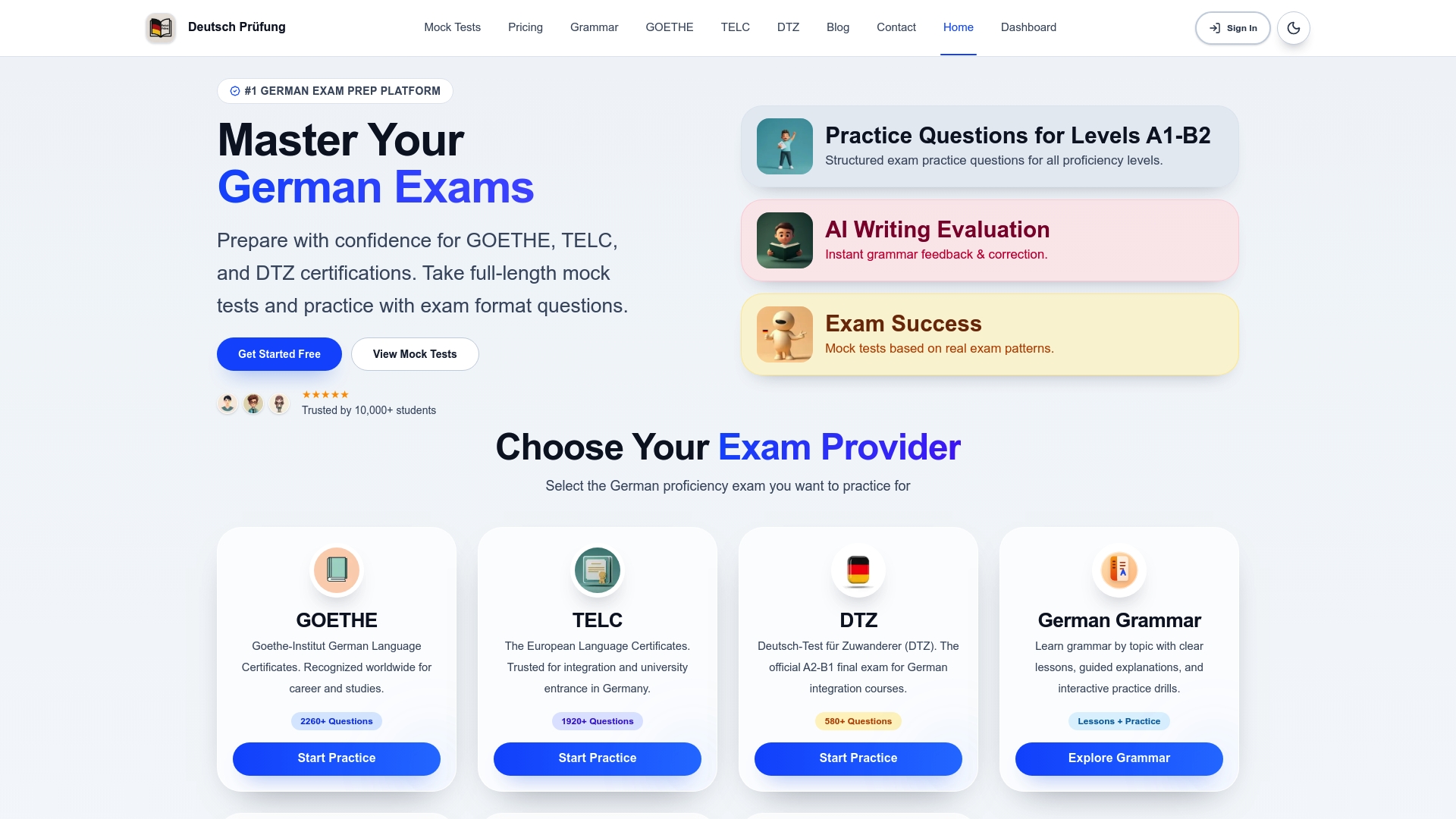
At Deutsch-Pruefung.de, you can access full-length Goethe practice tests that mirror real exam conditions across all four skill areas. Work through structured exercises, sharpen your grammar with the German grammar guide, and build exam confidence with timed Goethe mock tests designed to replicate the actual test experience. Whether you are starting at A1 or pushing toward B2, the platform offers level-specific resources that match exactly where you are in your preparation journey. Start with a free trial and see how targeted practice changes your results.
Frequently asked questions
What does the Goethe exam certificate prove?
It certifies your official German language proficiency at the level you passed. Goethe certificates are accepted by universities, employers, and immigration authorities worldwide.
How is the Goethe exam structured?
The exam consists of four sections: listening, reading, writing, and speaking, each assessed separately. The four-skill structure applies across all proficiency levels from A1 to B2.
How do I choose the right Goethe exam level?
Select the level that matches your learning goal, whether academic, professional, or immigration-related. Each certificate level is designed for specific study, work, or migration needs, so matching your goal to the level requirement is the most reliable approach.
What’s the difference between Goethe and TELC exams?
Goethe focuses more on communicative skills and carries broader international recognition, while TELC offers a wider range of test formats primarily within Europe. Both exams differ in style but are accepted as valid German language proficiency tests.