
Most people assume there’s only one certificate that gets you into a German university. That assumption can cost you time, money, and a missed application deadline. The truth is, several certificates are recognized for university admission in Germany, including TestDaF, DSH, Goethe-Zertifikat C1/C2, telc C1 Hochschule, and DSD II. Each one suits a different profile, location, and academic goal. Whether you’re a student planning to study in Germany or a professional seeking career advancement, this guide walks you through every major academic German certificate so you can make a confident, informed choice.
Table of Contents
- Defining academic German certificates
- Overview and comparison: The main academic German certificates
- How each certificate works: Format, levels, and what they measure
- Which certificate is right for you? Match your goals and profile
- Practical steps: How to prepare for academic German certificate exams
- Find your German certificate prep resources
- Frequently asked questions
Key Takeaways
| Point | Details |
|---|---|
| Academic certificates defined | These are advanced German language credentials recognized for university admission and higher-level careers. |
| Universities accept multiple types | TestDaF, DSH, Goethe C1/C2, telc C1 Hochschule, and DSD II are all officially recognized if requirements match. |
| Certificate choice matters | Select the certificate based on university location, exam format, and your academic or career needs. |
| Preparation is specialized | Effective preparation focuses on academic texts and lectures, with resources tailored to each exam’s structure. |
| Professional impact | Academic German certificates boost opportunities for higher education and advanced employment in German-speaking environments. |
Defining academic German certificates
An academic German certificate is not just any language qualification. It’s a formal credential that proves you can function at an advanced level in German, specifically in academic or professional contexts. Most universities and institutions require proficiency at B2, C1, or C2 on the Common European Framework of Reference for Languages (CEFR), a standardized scale that measures language ability from beginner (A1) to mastery (C2).
So what separates an academic certificate from a general German exam? Purpose and content. General exams like Goethe A2 or TELC B1 test everyday communication skills. Academic certificates, by contrast, assess your ability to understand lectures, write structured arguments, and engage with complex academic texts. As university admission standards confirm, these credentials are required primarily for higher education entry in Germany.
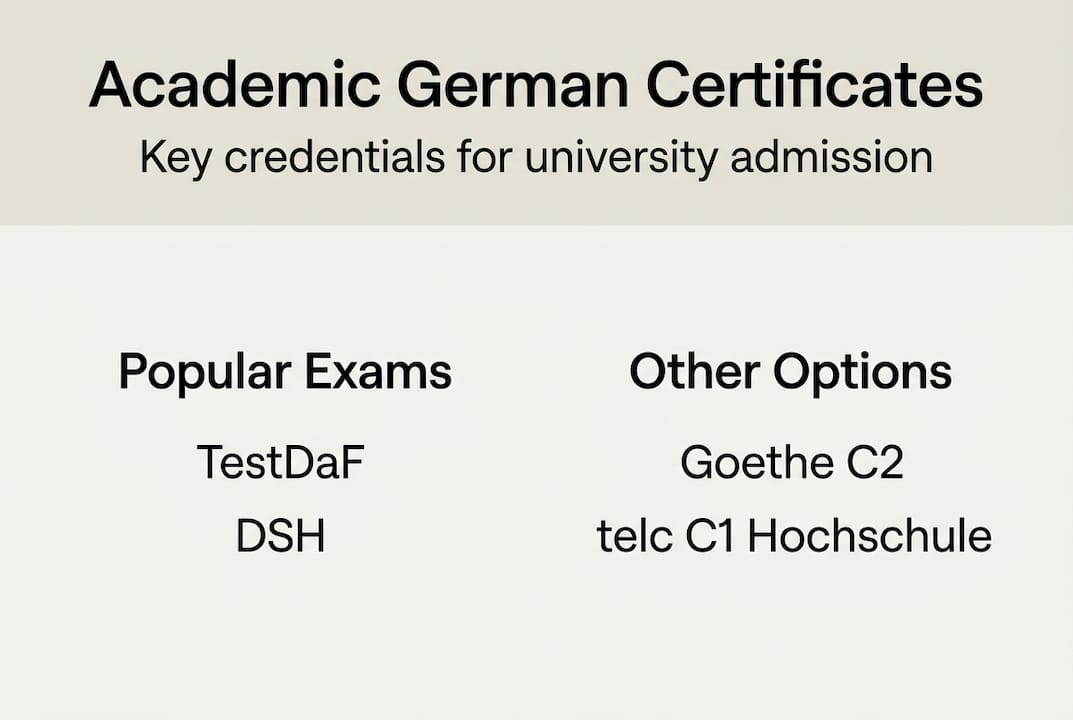
Here are the five primary recognized academic German certificates:
- TestDaF (Test Deutsch als Fremdsprache): Available worldwide, focused on academic language
- DSH (Deutsche Sprachprüfung für den Hochschulzugang): Administered by German universities, only in Germany
- Goethe-Zertifikat C1/C2: Internationally recognized, accepted by many universities
- telc C1 Hochschule: Specifically designed for higher education admission
- DSD II (Deutsches Sprachdiplom): Primarily for students in DSD-partner schools abroad
You need one of these certificates if you’re applying to a German-taught degree program, transferring credits internationally, or meeting language requirements for a skilled worker visa in Germany. Explore Goethe exam preparation and TELC exam preparation to understand which path fits your level.
Key insight: Not every certificate is accepted by every university. Always check the specific academic certificate requirements of your target institution before registering for an exam.
Overview and comparison: The main academic German certificates
Now that you know the landscape, let’s break down each certificate in more detail. The table below gives you a quick side-by-side view.

| Certificate | CEFR Level | Location | Academic Focus | Worldwide Availability |
|---|---|---|---|---|
| TestDaF | C1 (TDN4) | Worldwide | High | Yes |
| DSH | C1/C2 (DSH-2/3) | Germany only | Very High | No |
| Goethe C1/C2 | C1 or C2 | Worldwide | Moderate to High | Yes |
| telc C1 Hochschule | C1 | Worldwide | High | Yes |
| DSD II | C1 | Partner schools | High | Limited |
All of these certificates are equally valid for admission per the KMK (Kultusministerkonferenz, Germany’s Standing Conference of the Ministers of Education). That means no single certificate gives you an advantage over another, as long as it meets the required level. However, TestDaF and DSH are considered more academically focused in their content and format compared to the general Goethe exams.
For a deeper look at how these exams differ in practice, the TELC vs Goethe exam guide is a useful starting point. You can also strengthen your foundation with the German grammar guide before tackling any of these exams.
Pro Tip: If your target university is in Germany and you’re already living there, the DSH may be your most convenient option since it’s offered directly by the university you’re applying to, often at a lower cost.
How each certificate works: Format, levels, and what they measure
Understanding the structure of each exam helps you prepare more efficiently. Here’s a numbered breakdown of what each major certificate involves:
- TestDaF: Four sections covering reading (Lesen), listening (Hören), writing (Schreiben), and speaking (Sprechen). Each section is scored on a scale of TDN3 to TDN5. Most universities require TDN4 in all sections, which corresponds to C1.
- DSH: A university-conducted exam with written and oral components. The written part includes reading comprehension, academic text structures, and a listening exercise. DSH-1 allows limited programs, DSH-2 covers most programs, and DSH-3 is for advanced academic needs.
- Goethe-Zertifikat C1/C2: Four skills tested (reading, listening, writing, speaking). C1 is accepted by many universities; C2 (Großes Deutsches Sprachdiplom) is the highest level and widely respected.
- telc C1 Hochschule: Specifically built for higher education. It tests academic reading, listening, writing, and speaking with university-relevant content.
Here’s a quick data overview for the DSH exam specifically:
| DSH Level | Score Range | Admission Eligibility |
|---|---|---|
| DSH-1 | 57–66% | Limited programs |
| DSH-2 | 67–81% | Most degree programs |
| DSH-3 | 82–100% | All programs |
📊 Statistic callout: The DSH exam fee ranges from approximately €100 to €160, depending on the university. A DSH-2 score requires achieving between 67% and 81% across all exam components.
For targeted practice, the TELC B2 reading guide and the TELC B2 exam guide are excellent resources to build the reading and comprehension skills that transfer across all academic exams. Always verify your target institution’s specific German university requirements before choosing your exam.
Which certificate is right for you? Match your goals and profile
Choosing the right certificate comes down to a few key factors. Use this checklist to narrow your options:
- Where are you located? If you’re outside Germany, DSH is not an option. TestDaF, Goethe, and telc C1 Hochschule are available internationally.
- What’s your target university? Some universities accept all certificates; others specify TestDaF or DSH. Check the admissions page directly.
- What’s your exam style preference? TestDaF and DSH use academic texts and lectures as their primary content. Goethe exams are broader but overlap significantly at C2.
- What’s your timeline? TestDaF has fixed global test dates. DSH is offered by individual universities on their own schedule.
- Are you applying for professional or immigration purposes? Some visa categories accept Goethe C1 or telc C1 as proof of language ability.
A common pitfall is registering for the wrong exam level. If your university requires C1 and you sit a B2 exam, it won’t count, even if you pass with a perfect score. For learners still building toward B1 or B2, the DTZ test practice and TELC B1 exam guide can help you build a strong foundation before moving to academic-level exams.
Pro Tip: If you’re unsure between TestDaF and telc C1 Hochschule, consider your comfort with standardized testing formats. TestDaF uses a uniform global format; telc C1 Hochschule may feel more flexible in its oral component.
Practical steps: How to prepare for academic German certificate exams
Preparation is where most candidates either gain or lose their edge. Here’s a step-by-step approach that works across all academic German exams:
- Identify your target exam and level. Confirm with your university or employer which certificate and score they require. Check official certificate requirements to avoid surprises.
- Assess your current level. Take a placement test or mock exam to see where you stand. This tells you how much preparation time you realistically need.
- Focus your study on exam-specific content. For TestDaF and DSH, prioritize academic reading and listening. Practice summarizing lectures, writing structured essays, and understanding complex arguments. For Goethe C1/C2, broaden your vocabulary and work on fluency across all four skills.
- Practice with authentic materials. Use past papers, official sample questions, and timed mock tests. The German grammar guide is a strong resource for reinforcing the structural accuracy that academic exams demand.
- Simulate exam conditions. Time yourself. Practice writing under pressure. Record your speaking responses and review them critically.
- Register early. TestDaF and Goethe exam slots fill up quickly, especially in peak application seasons. The Goethe exam preparation page can help you understand registration timelines and what to expect on exam day.
Pro Tip: For the DSH, which costs between €100 and €160 per attempt, preparation is especially important since retake opportunities are limited and tied to university schedules. Treat every practice session as a real exam.
One more thing: don’t underestimate the oral component. Many candidates over-prepare for writing and neglect speaking. Academic German exams test your ability to present and defend ideas verbally, not just write them.
Find your German certificate prep resources
You now have a clear picture of which academic German certificates exist, how they compare, and what each exam involves. The next step is putting that knowledge into action with the right study tools.
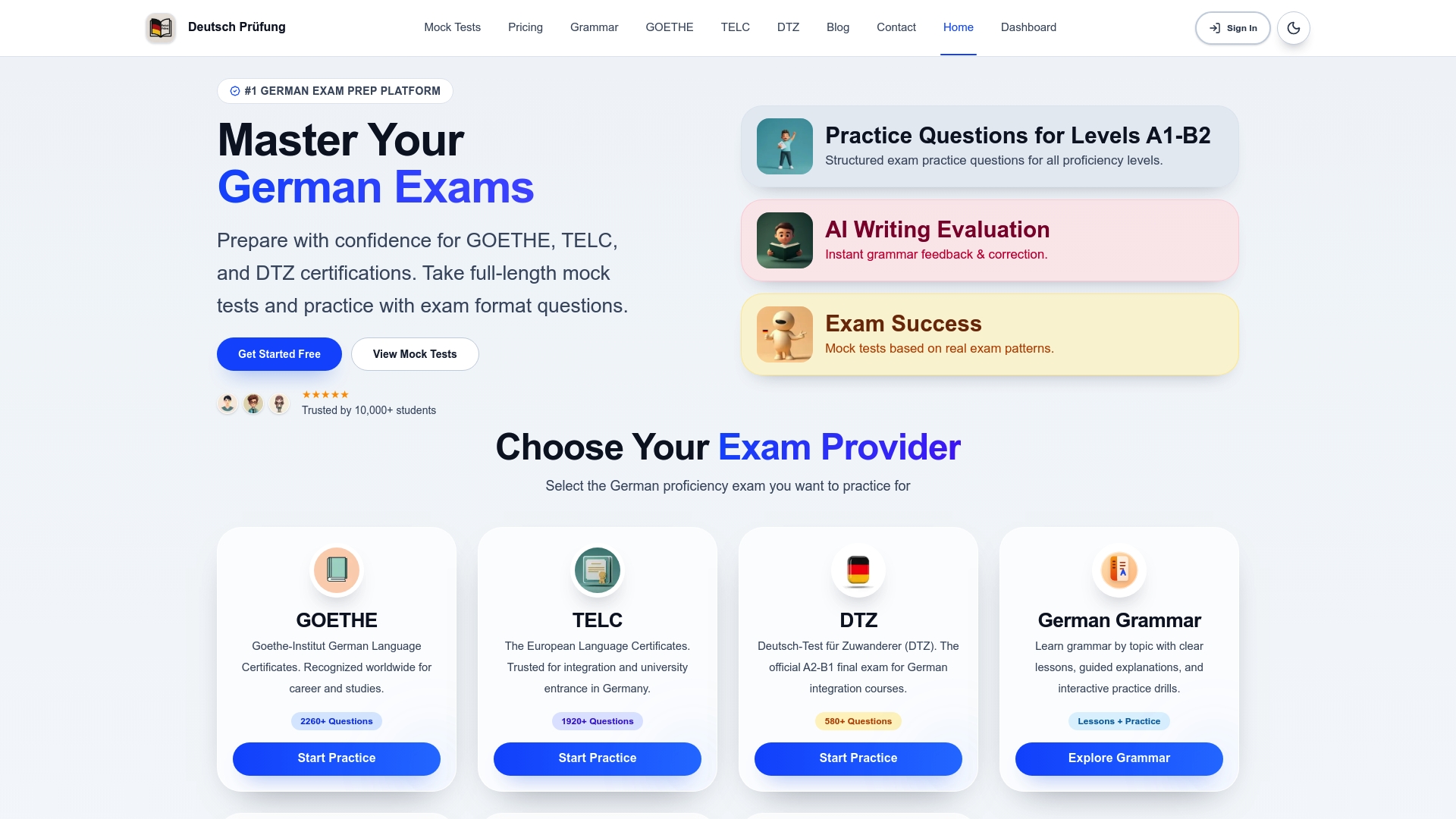
Deutsch-Pruefung.de offers structured practice resources for every major academic German exam. Whether you’re targeting the Goethe-Zertifikat through Goethe exam preparation, working toward telc C1 Hochschule via TELC exam preparation, or sharpening your grammar accuracy with the German grammar guide, you’ll find mock tests, AI-powered writing feedback, audio exercises, and expert exam guides all in one place. Free trial options are available, so you can explore the platform before committing to a plan. Start where you are, build steadily, and walk into your exam with confidence.
Frequently asked questions
Are all academic German certificates equally valid for university admission?
Yes. Certificates such as TestDaF, DSH, Goethe C2, telc C1 Hochschule, and DSD II are all equally valid per KMK for university admission, provided they meet the required proficiency level.
Is the DSH exam only available in Germany?
Yes. The DSH is university-conducted and must be taken at a German university within Germany, making it unavailable to applicants still living abroad.
What level do most German universities require on academic certificates?
Most programs require C1-level German, such as TestDaF TDN4 or DSH-2. Some highly competitive programs may require DSH-3 or Goethe C2.
How are academic German certificate exams structured?
Most include written, listening, and oral sections. The DSH includes comprehension, academic text structures, and a listening component in addition to an oral exam.
What’s the best way to prepare for academic German certificate exams?
Focus on academic reading and listening for TestDaF and DSH, and broaden your language range for Goethe. TestDaF and DSH emphasize academic texts and lectures, so targeted practice with authentic materials is essential.