

Mastering German vocabulary can feel overwhelming when you’re preparing for A1 through B2 certification exams. Many learners struggle with retention, forgetting words they studied just days before test day. The good news is that scientifically backed strategies like spaced repetition, thematic learning, and active recall can transform your vocabulary acquisition from frustrating to effective. This guide walks you through proven methods to build lasting German vocabulary that sticks for exam success and real-world communication.
Table of Contents
- Key takeaways
- Understanding your vocabulary learning challenges
- Preparing your study plan with proven tools and themes
- Executing active recall and multi-sensory vocabulary practices
- Avoiding pitfalls and verifying progress towards exam readiness
- Boost your German exam success with expert support
- FAQ
Key Takeaways
| Point | Details |
|---|---|
| Spaced repetition boosts retention | Using spaced repetition helps you retain German vocabulary longer by reinforcing memory just as you are about to forget. |
| Thematic learning aids recall | Grouping vocabulary by theme creates meaningful connections that make recall easier during exams and real world use. |
| Active recall strengthens memory | Practicing active recall by testing yourself strengthens memory and reduces forgetting between study sessions. |
| Break down compounds and idioms | Breaking German compounds into smaller parts and studying idioms in context makes them easier to understand. |
| Regular spaced practice beats cramming | Consistent spaced practice beats cramming and builds readiness for exams. |
Understanding your vocabulary learning challenges
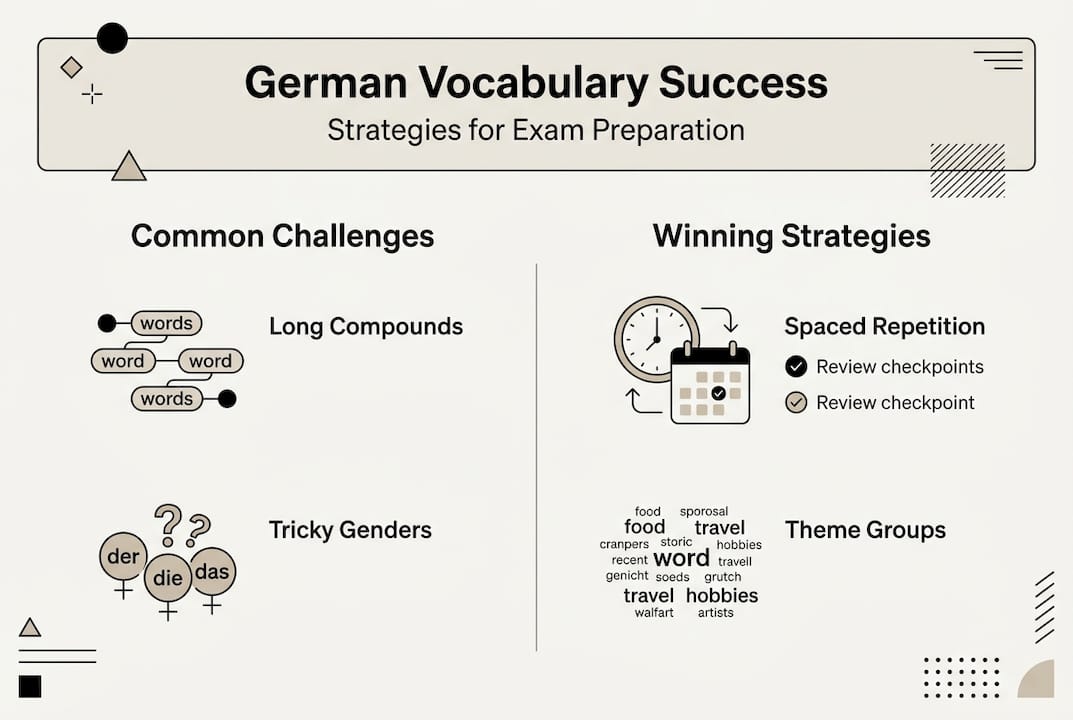
German learners face unique obstacles when building vocabulary for certification exams. You might recognize the frustration of studying hundreds of words only to blank during practice tests. This happens because traditional methods like cramming create weak memory connections that fade quickly. Research shows the spacing effect produces better retention after one to five weeks compared to massed practice, with retrieval strength increasing through multiple practice rounds.
Massed practice, where you study vocabulary intensively in short bursts, feels productive but delivers poor results. Your brain needs time between exposures to consolidate information into long-term memory. When you cram 50 words the night before a quiz, you might recall them temporarily, but they vanish within days. Spaced repetition leverages natural forgetting curves by presenting words just as you’re about to forget them, reinforcing neural pathways each time.
Beyond timing issues, many learners ignore critical details that German exams test directly:
- Grammatical gender assignments that change meaning and usage
- Collocations showing which words naturally pair together
- Contextual usage differences between similar terms
- Compound word structures unique to German
German compounds like “Geschwindigkeitsbegrenzung” (speed limit) intimidate learners who treat them as single, incomprehensible units. Breaking them into “Geschwindigkeit” (speed), “Begrenzung” (limit) makes them manageable. Idioms present similar challenges because literal translations fail. “Jemandem die Daumen drücken” translates word for word as “press someone’s thumbs,” but means “keep fingers crossed.” Without understanding these patterns, you’ll struggle with exam reading comprehension and writing tasks.
Pro Tip: Track which word types you forget most often. If you consistently miss feminine nouns or separable verbs, create dedicated practice sessions targeting those weaknesses rather than reviewing everything equally.
Preparing your study plan with proven tools and themes
Effective vocabulary building starts with the right organizational framework. Spaced repetition software like Anki automates the timing science we discussed, presenting cards at optimal intervals. These programs track which words you know well and which need more exposure, eliminating guesswork from your study schedule. You input vocabulary with example sentences, and the algorithm handles scheduling.
Thematic vocabulary grouping dramatically improves retention by creating mental categories. When you learn “Umwelt” (environment), immediately add related terms like “Verschmutzung” (pollution), “Nachhaltigkeit” (sustainability), and “Klimawandel” (climate change). Your brain stores these connections together, making recall easier during exam situations when topics cluster naturally.
Consider organizing vocabulary into these exam-relevant themes:
| Theme Category | Example Vocabulary | Exam Relevance |
|---|---|---|
| Work and Career | Bewerbung (application), Gehalt (salary), Kollege (colleague) | B1-B2 writing tasks, speaking scenarios |
| Environment | Recycling (recycling), Müll (garbage), erneuerbar (renewable) | Reading passages, opinion essays |
| Daily Life | Einkaufen (shopping), Haushalt (household), Termin (appointment) | A1-A2 dialogues, practical situations |
| Education | Studium (studies), Prüfung (exam), Abschluss (degree) | All levels, especially B2 formal contexts |
| Health | Arzt (doctor), Krankheit (illness), Behandlung (treatment) | Listening comprehension, role plays |
Word families and collocations deserve special attention. Instead of memorizing “machen” (to make) in isolation, learn it within phrases: “Hausaufgaben machen” (do homework), “einen Fehler machen” (make a mistake), “Fortschritte machen” (make progress). This chunked approach mirrors how native speakers actually use language and prepares you for natural-sounding exam responses.
Context matters enormously for retention. A bare flashcard reading “schnell = fast” provides minimal learning value. Transform it into “Der Zug fährt schnell durch die Stadt” (The train travels quickly through the city). Now you’ve encoded the word with grammatical context, typical usage, and a mental image. Your brain has multiple retrieval pathways instead of one fragile connection.

Pro Tip: Update your spaced repetition decks monthly with vocabulary from official exam practice materials. This ensures you’re learning words that actually appear in certification tests rather than random terms from generic lists.
Executing active recall and multi-sensory vocabulary practices
Active recall transforms passive recognition into genuine mastery. Rather than rereading vocabulary lists hoping words will stick, you force your brain to retrieve information without prompts. This retrieval practice strengthens memory far more effectively than recognition-based study. Multi-sensory methods and output practice create robust neural connections that survive exam pressure.
Follow these steps to implement active recall effectively:
- Create sentence-based flashcards with the target word in context, not isolated translations. Front side shows the German sentence with the target word bolded. Back side provides the English meaning and any grammatical notes.
- Practice retrieval by attempting to recall the meaning before flipping the card. If you simply recognize it when you see the answer, you haven’t truly recalled it. Cover the answer and speak it aloud first.
- Apply new vocabulary immediately through speaking and writing tasks. After learning 10 environment-related words, write three sentences about climate change using them. Record yourself discussing environmental issues.
- Review cards according to your spaced repetition schedule without skipping sessions. Consistency matters more than duration. Fifteen minutes daily beats two-hour weekend marathons.
- Adjust difficulty ratings honestly. If you hesitated or partially recalled a word, mark it as difficult so the algorithm schedules it sooner.
Mnemonics help with particularly stubborn vocabulary. For “die Schildkröte” (turtle), visualize a turtle carrying a shield (“Schild”) on its back. The image creates a memorable hook that pure repetition cannot match. Irregular verbs like “nehmen” (to take) benefit from exaggerated mental scenes. Picture yourself dramatically “taking” something while shouting “nehmen” to cement the connection.
Multi-sensory integration engages different brain regions simultaneously. When learning “der Bahnhof” (train station), read it silently, write it three times by hand, speak it in a sentence, and listen to native pronunciation. Each sensory mode reinforces the others. Handwriting activates motor memory that typing cannot replicate. Speaking reveals pronunciation challenges you’d miss through silent reading.
Pro Tip: Record yourself using new vocabulary in spontaneous sentences, then listen back critically. You’ll catch pronunciation errors and awkward phrasing while reinforcing the words through auditory processing. This doubles as speaking practice for oral exam components.
The testing effect demonstrates that retrieval practice itself enhances learning beyond the immediate study session. Each time you successfully recall “die Versicherung” (insurance) from memory, you’re not just checking knowledge but actively strengthening it. This explains why practice tests improve scores more than rereading notes.
Avoiding pitfalls and verifying progress towards exam readiness
Common mistakes undermine even dedicated study efforts. Recognizing these pitfalls helps you avoid wasting time on ineffective practices. Many learners focus exclusively on vocabulary quantity while ignoring the qualitative details that exams actually test.
Watch for these critical errors:
- Ignoring grammatical gender leads to agreement mistakes throughout your exam responses. Always learn “der Tisch,” “die Lampe,” “das Buch” with articles, never bare nouns.
- Neglecting collocations produces unnatural language. You “make a decision” in English but “treffen eine Entscheidung” in German. These patterns aren’t interchangeable.
- Cramming vocabulary the week before exams creates the illusion of knowledge that evaporates under test conditions. Spaced repetition yields 25% better memorization with retrieval improving after multiple practice rounds.
- Skipping systematic review allows early vocabulary to fade while you focus on new words. Your foundation crumbles as you build upward.
- Learning words in isolation without example sentences strips away grammatical and contextual information you need for actual usage.
German compound words require deliberate breakdown strategies. “Krankenversicherung” (health insurance) combines “krank” (sick), “Versicherung” (insurance). Understanding component parts helps you decode unfamiliar compounds during reading comprehension sections. Idioms need contextual learning because literal translations mislead. “Das ist nicht mein Bier” literally means “That’s not my beer” but actually means “That’s not my problem.” Learn these through example dialogues showing appropriate usage contexts.
| Approach | Retention After 1 Month | Retention After 3 Months | Exam Performance Impact |
|---|---|---|---|
| Cramming | 15-25% | 5-10% | Poor, high stress, inconsistent |
| Immersion Only | 40-50% | 30-40% | Moderate, gaps in formal vocabulary |
| Spaced Repetition | 70-80% | 60-70% | Strong, confident recall under pressure |
Regular self-testing reveals gaps before exam day. Use official practice materials to simulate test conditions monthly. Time yourself strictly and grade honestly. If you consistently miss vocabulary in reading passages about technology, dedicate extra study time to that theme. Patterns in your mistakes guide targeted improvement.
Empirical benchmarks provide realistic expectations. Progressing from B1 to B2 typically requires 300 to 400 hours of focused study over six to nine months of intensive practice. This timeline assumes consistent effort with effective methods. Cramming cannot compress this developmental process. Your brain needs time to consolidate vocabulary into accessible long-term memory.
Track measurable progress through weekly metrics. Count how many words you can actively produce in writing versus passively recognize while reading. Production ability matters more for exam success. Monitor how quickly you complete practice reading passages as vocabulary automaticity improves. Record yourself speaking on exam topics and note fluency improvements over time.
Verification goes beyond counting flashcards reviewed. Can you use new vocabulary spontaneously in conversation? Do you recognize words instantly in reading passages without conscious translation? Can you produce accurate written sentences under time pressure? These practical applications prove genuine acquisition versus superficial familiarity.
Boost your German exam success with expert support
You’ve learned powerful strategies for building German vocabulary through spaced repetition, thematic organization, and active recall. These self-study methods form your foundation, but professional resources accelerate progress significantly. Structured practice tests reveal exactly which vocabulary gaps remain before exam day.
Deutsch Prüfung offers comprehensive exam preparation resources tailored to A1 through B2 certification levels. The platform provides full-length mock tests matching official exam formats, targeted vocabulary exercises organized by theme and difficulty, and AI-powered writing evaluation that identifies specific areas needing improvement. You’ll find audio exercises for listening comprehension that expose you to vocabulary in natural spoken contexts, grammar lessons explaining the rules governing word usage, and official question bank resources ensuring your practice mirrors actual test content. Mobile apps let you practice vocabulary during commutes or breaks, maximizing study efficiency. Whether you’re preparing for GOETHE, TELC, or DTZ exams, combining your self-study strategies with structured professional resources gives you the best chance of certification success.
FAQ
How long does it typically take to build a solid German vocabulary for B1 to B2 levels?
It usually requires 300 to 400 hours of focused study, often over six to nine months of intensive practice. Consistent spaced repetition and active use speed this process. Individual timelines vary based on prior language experience and daily study commitment, but expecting rapid progress in weeks sets unrealistic expectations.
What tools are best for ensuring long-term German vocabulary retention?
Spaced repetition programs like Anki combined with sentence-based flashcards are highly effective. Mnemonics and active recall practices enhance memory retention beyond simple recognition. Multi-sensory approaches incorporating reading, writing, speaking, and listening create robust neural pathways that survive exam pressure.
How can I effectively learn complex German compounds and idioms?
Break down compounds into smaller component words to understand meaning. “Geschwindigkeitsbegrenzung” becomes manageable as “Geschwindigkeit” plus “Begrenzung.” Learn idioms in context through example sentences showing appropriate usage rather than memorizing literal translations that mislead.
Is cramming vocabulary effective for German certification exams?
Cramming leads to poor long-term retention and is less effective than spaced repetition. Consistent, spaced practice yields better exam performance because your brain needs time between exposures to consolidate information into accessible long-term memory. Cramming creates temporary familiarity that evaporates under test conditions.
Should I learn vocabulary with or without grammatical gender markers?
Always learn nouns with their articles: “der Tisch,” “die Lampe,” “das Buch.” Gender affects adjective endings, pronoun references, and overall grammatical accuracy throughout your exam responses. Ignoring gender during initial learning creates persistent errors that require extensive correction later.